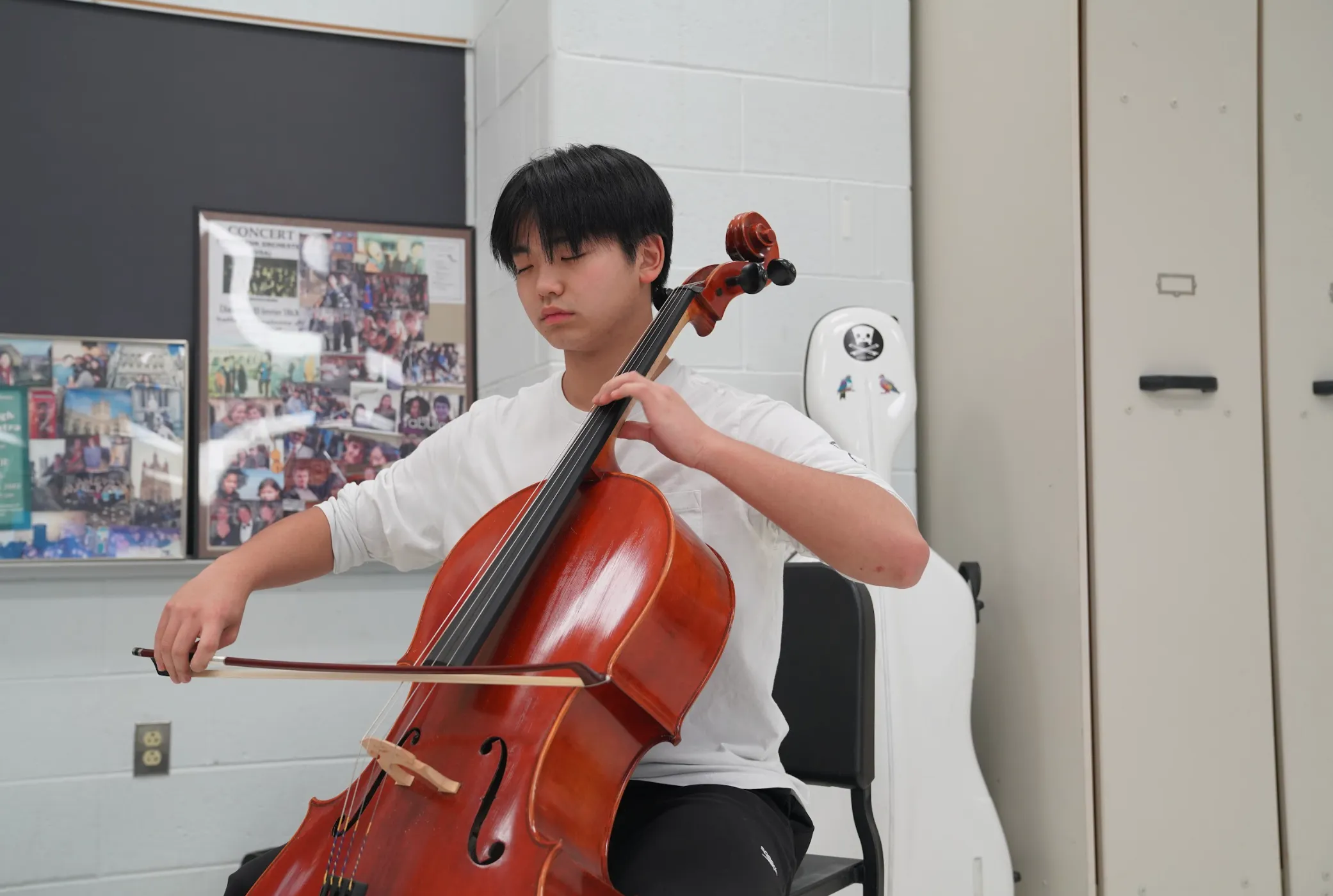
From being first chair cellist in the PHS Orchestra to performing with the Heifetz Institute, Seigo Iwata ’26 immerses himself in the world of music. Iwata has been playing for 13 years, starting the cello when he was only four years old. He plans to bring his passion for music to college, where he will take the next steps in his music career.
What is your favorite part about playing the cello?
I’d say my favorite part is probably chamber music, since I can collaborate with other people. [It’s] a team building kind of thing where everyone has to do their best, because if even one person slacks off, it’s bad.
Who is your favorite composer? Favorite piece of music?
My favorite composer is Gabriel Fauré and my favorite piece of music is String Quartet No. 2 by Mendelssohn.
What inspired you to start playing cello?
My mom made me and all of my siblings play a musical instrument from a young age, and we had to continue it through middle school. I made a promise to my mom that if I didn’t like it, I would quit as soon as I went to high school. But then I went to Meadowmount School of Music, I was like, “Okay, I actually want to do this.” Around sophomore year was when I genuinely started to want to pursue music in the future. Mainly, that was thanks to the Heifetz Institute, where I was in a chamber group with two violinists. I got along really well with those people, and it really made chamber music fun for me.
What was your experience like at the Tanglewood Institute?
I was in the string quartet program last year, and this year I was in the orchestral program. It was really fun, but it’s a very intense program. It was over the summer for six weeks. I met all kinds of people. For string quartet, it was four hours of rehearsal every morning, from 8:30 a.m. to 12:30 p.m. with coachings. But then for the orchestra, it was only three hours of rehearsal in the morning. For the string quartet, we do two performances. We have one week to learn two or three string quartets and then play them. And then for the orchestra, you’d have three two week sessions.
What makes the cello unique?
There’s a famous saying that the cello is the closest to [the human] voice. I think that’s definitely kind of true because a lot of really famous somber pieces ... are written [for] cello. [These pieces] are all very heart wrenching pieces. And I think the cello is definitely the only instrument that ... can produce that sound. But there’s also a lot of drawbacks: we can’t play very high and can’t project as much. But I’d say it’s the most resonant out of the string instruments.
What advice would you give to someone who wants to play the cello?
If you want to play cello, I’d say you need to find a viable teacher because there’s so many things you have to get out of the habit of doing, even if you haven’t played an instrument. I played for seven years, and then I met a new teacher, I realized I’d been doing basically everything wrong. I had to completely relearn everything about how I played, and it really helped.
What is your favorite part about playing in the PHS Orchestra?
I’d say my favorite part about playing in PHSO is the musical and the winter concert because both are things in which we collaborate with parts of the arts department with.
What is the most challenging part about playing with the orchestra?
The most challenging part is working with the conductor. I’ve also talked to other musical professionals and ... they all said the same thing of whether the conductor will listen to you, and then whether the orchestra can pay attention to what you’re playing and match that. But it’s mainly the conductor who controls the orchestra. So, if the conductor doesn’t listen to you, you’re just on your own.
Do you want to play any other instruments?
I really want to play viola because you can play a lot of different types of music. The cello is great, but sometimes it’s not very useful, because sometimes you’re only given bass notes and things like that. On the other hand, the viola is kind of downplayed. But honestly, a good violist is insanely useful.