The Apartment (1960) dir. Billy Wilder
Winter on the East Coast is cold, dark, and long, and stepping out of the biting cold into the warmth of one’s home is a relief like no other. Some though, like the lead character of “The Apartment,” C.C. Baxter (Jack Lemmon), have nowhere to go — although his circumstances are rather unique. The affable if lily-livered office worker is lonely and it’s the holidays, but he has found himself in the habit of loaning out his Upper West Side apartment to the higher-ups at his company for their extramarital trysts.
Soon enough, Baxter is contacted by personnel director Jeff Sheldrake (Fred MacMurray), who tells Baxter that he will be promoted if he allows Sheldrake use of the apartment. Baxter agrees, and asks an elevator girl, Fran Kubelik (Shirley MacLaine), out for that night. She agrees, but ends up standing him up for a date with none other than Sheldrake, with whom she has had an off-and-on affair.
Both characters are lonely, and the decision to set the movie over the winter holidays (major plot events happen on Christmas and New Year’s Eve respectively) reflects their state of mind. Though these holidays are typically times to rejoice with your loved ones, Baxter and Kubelik instead endure a series of heartbreaking rejections and setbacks in their relationships with other people.
Lemmon’s fantastic performance and the jokes packed densely into the script manage to transform what seems like a somewhat miserable plot, however, into — miraculously — a comedy, and a great one at that. Though “The Apartment” has been overshadowed by other romantic comedies from the same period like “Breakfast at Tiffany’s” and “Some Like it Hot,” it is one of the best films to come out of the 1960s and deserves a reputation as not only a great film but a perfect one for the winter holidays.
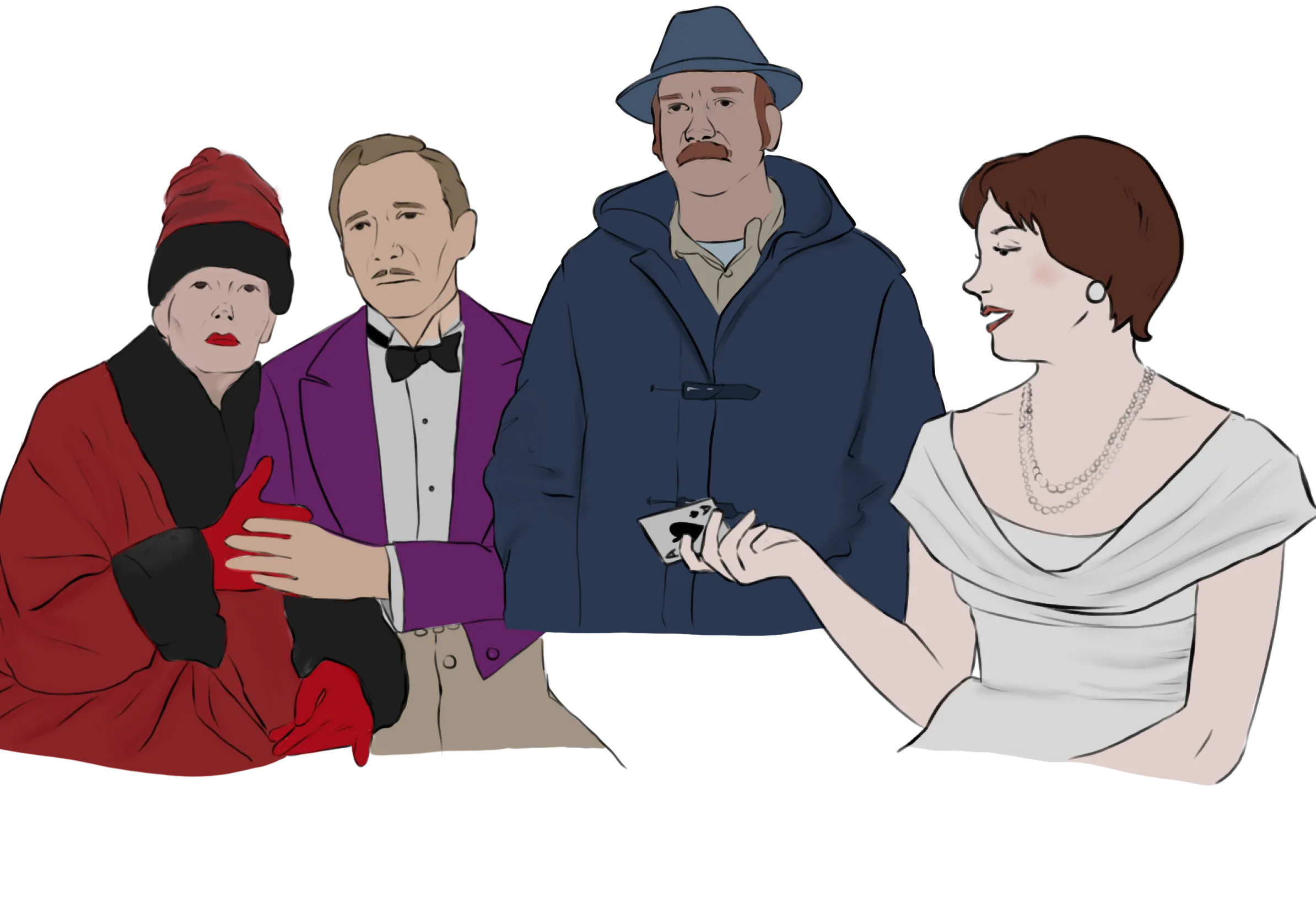
The Grand Budapest Hotel (2014) dir. Wes Anderson
Though it does not once mention Christmas, Hanukkah, or New Year’s, there is no doubt in my mind that “The Grand Budapest Hotel” is a film for the winter holidays. It is a story within a story within a story, established in an opening sequence of a woman visiting the grave of an author who wrote a book about his visit to the titular hotel, where he was told a story by the proprietor, Zero Moustafa (Tony Revolori). The eccentricity in the framing of the story is present in virtually every other aspect of the film, from the pastel color palette, to each frame’s stilted symmetry, to the miniature models of the hotel. Anderson is one of the most distinct directors of our age, and “The Grand Budapest Hotel” is an extravagant aesthetic indulgence, both visually beautiful and absurdly unnatural.
The bulk of the story follows Gustave H. (Ralph Fiennes), a prim, poetry-loving concierge at the Grand Budapest who rules stringently over the staff and dotes on the elderly female patrons. Though there is a plot, involving a stolen painting, prison escape, and secret society of hotel concierges, it takes the back burner for the film’s more pressing thematic concerns, particularly nostalgia. Though the range of confectionary colors and dollhouse-esque sets evoke childhood aesthetics (further evidence of it being a holiday movie), more specifically, the somewhat ridiculous yet eminently respectable Gustave is a dandy committed entirely to the kind of high-end service that, as chronicled by the gradual degradation of the hotel, was in its dying throes at the time.
Though the Grand Budapest is located in a fictional Republic of Zubrowka, the phases it goes through are not unfamiliar to the 21st-century viewer: the colorful, glamorous 1930s giving way to a Nazi-equivalent occupation, and then finally the Iron Curtain-era dilapidation and grayness. Despite its highly unnatural and stylized composition and the layer of fiction separating our world from Anderson’s, “The Grand Budapest Hotel” imparts serious messages about fascism and art. It is also wildly entertaining, with a pitch-perfect comedic performance from Fiennes alongside Anderson’s crew of regulars, including Bill Murray and Owen Wilson.
The Holdovers (2023) dir. Alexander Payne
“History is not simply the study of the past, it is an explanation of the present,” the curmudge only teacher Paul Hunham (Paul Giamatti) says in “The Holdovers,” a snowy dramedy set in a New England boarding school over winter break. Indeed, when a Focus Features logo customized to look retro flickers onto the screen, it’s made clear that “The Holdovers” is a film concerned with the past. Shot digitally, then edited to emulate film, it’s composed like a film from the 1970s, with Cat Stevens songs playing quietly over long shots of empty school halls and snowy Boston. But the quietly moving pain of the three lead characters, along with the unlikely bonds they form because of it, make this story still deeply resonating in the present day.
When Hunham fails the son of a major donor, his administration-prescribed punishment is to stay at the school and supervise the unruly group of boys “holding over,” the sort of rich, insubordinate brats he despises. Soon, however, most of the holdovers are picked up by one student’s magnanimous father, leaving only a student of Hunham’s named Angus Tully (Dominic Sessa). The head cook Mary Lamb (Da'Vine Joy Randolph), grief-stricken from her son’s death in the Vietnam War, joins them, and the three form an awkward trio, with each member initially concerned only with their own holiday melancholy. Through the events of the film, the three form a genuine bond that transcends their unfortunate circumstances.
The film is anchored by the three strong lead performances, particularly Randolph’s, who has been given the rawest emotional moments and does beautifully with them. It’s a quiet movie, fuzzy around the edges like childhood Christmas memories, and though the plot may not exactly move at breakneck speed I always find myself wishing at the end that Hunham, Angus, and Mary’s stories could last just a little bit longer. “The Holdovers” is a new, offbeat addition to my December movie rotation that manages to be heartwarming without being saccharine and melancholy without being maudlin, despite occasionally falling prey to holiday-movie clichés.