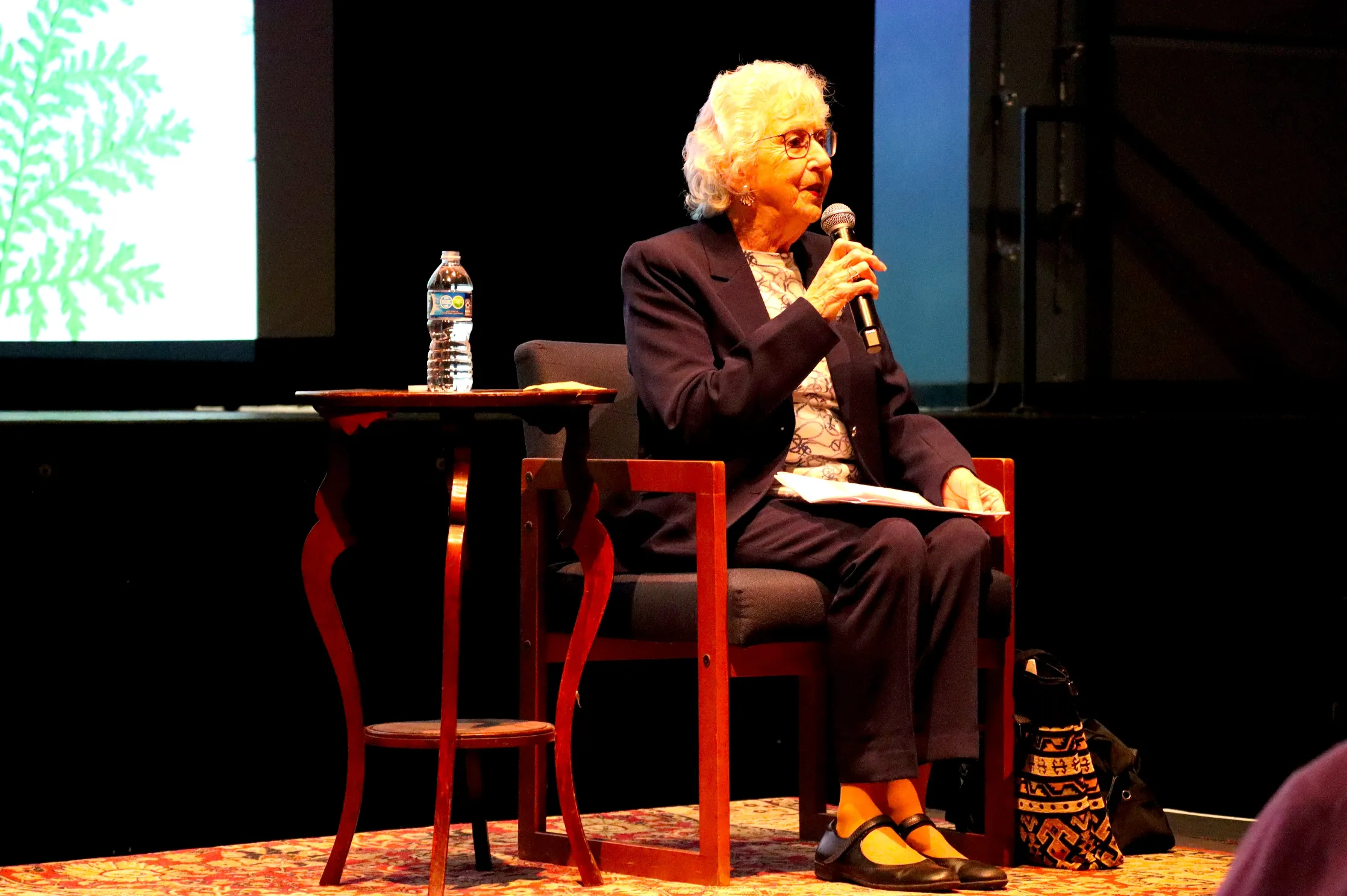
On Monday December 1, PHS hosted Maud Dahme, a Holocaust survivor from the Netherlands, who shared her story of being a hidden child during World War II. The PHS and larger Princeton community was invited to hear firsthand accounts of perseverance and hope from a woman who experienced one of history's darkest chapters.
Dahme was born in Amersfoort, in the Netherlands in 1936. Her father was a chef, who, along with her grandfather, operated a restaurant in a local train station. In 1939, Hitler invaded Poland, beginning World War II.
“The Netherlands.. was expected to remain neutral in [World War II]. That's why so many people came to the Netherlands, because everyone felt they would be safe.” said Dahme. “But that didn't happen: we woke up one morning in the middle of the night, [at] two in the morning in May of 1940 people… looked outside and they saw German airplanes coming in and soldiers parachuting out. Hitler [had] invaded.”
Dahme’s local synagogue soon received a letter that all Jews in Amersfoort were to take a train towards Eastern Europe, where unbeknownst to them many would be eventually murdered in concentration camps. Dahme’s parents decided to put their daughters in the care of their Christian friends. Through the resistance, these friends were able to find a farm in the countryside to hide Dahme and her sister.
“We get to a house in the neighborhood, we get to the garden gate, and my dad gave me the two little suitcases, and he said, ‘We'll see you in a couple of weeks – go in that house, and take very good care of your little sister,” said Dahme.
Her childhood was incredibly difficult, but even amidst the evil of World War II Dahme found goodness in people. Dahme recalled one moment when she brought to visit a young Jewish boy who was hiding from the Nazis by living under a trap door.
“I was [instructed to bring] him something to eat once a day, but [to] be very careful that nobody [saw] me. [And] everything was fine until one day I brought him something to eat, and came back up with the pot in my hand and looked, and there were half a dozen German soldiers standing there just looking at me. I put the trap door down. They stood and watched,” said Dahme.
Dahme recalls praying every night that her action would not lead to the arrest or murder of the boy, her guardians during the war, or her and her sister, and to her relief, it never never did.
“[When] I became an adult, I realized what happened there. These were soldiers who had been drafted into the army, or they were not Nazis, and probably had families of their own and children, and just pretended they never saw this. Even amongst all this evil that was going on, there was goodness also, and [that] saved our lives.”
Dahme’s village was eventually liberated by Allied soldiers, but even after the war was over many who survived the Holocaust, including Dahme, did not want to speak up about their experiences.
“[They] didn't want to talk about it, not even my own parents. They said, ‘[it’s] over and done, life has to go on. We're not going to talk about it,” said Dahme.
When Dahme moved to the United States in 1950, she remained silent for many years, in part because of her poor English. It was not until later in her life that she decided that it was time to tell her story. In March of 1981, she saw a program on 60 Minutes about a man named Raul Wamberg who saved many Hungarian Jews during the war. The next week, the presenters shared viewer reactions to the program, including a harmful conspiracy theory from someone Dahme knew personally.
“The Jews of Europe were not exterminated in gas chambers. The gas chambers were wartime propaganda fantasies,” the comment read.
The fact that someone she knew could deny the horrible events of the Holocaust shook Dahme deeply, pushing her to communicate the horrific truths of the Holocaust.
“This is when I decided I was going to start to speak up. It was very difficult at first, because these were things that were back in my head. I never talked about them. And when you start to tell a story of some experience, as you're describing it, you're seeing it, you're reliving it. But I decided the time had come that I should speak,” said Dahme.
Dahme has since written a book about her experience as a hidden child and talked to countless students and teachers across New Jersey, eventually leading to her induction into the New Jersey Hall of Fame in 2014. Superintendent Michael LaSusa first met Dahme in his previous school district, and decided it was important she come to PHS too.
“Education is what prevents hatred and intolerance. Understanding other people, understanding oneself, having respect for other people, all of that is what we hope to foster when we educate anybody, children and adults. Hearing [Dahme’s] message … reinforces the importance of education as a means of understanding others and reducing … intolerance,” said LaSusa.