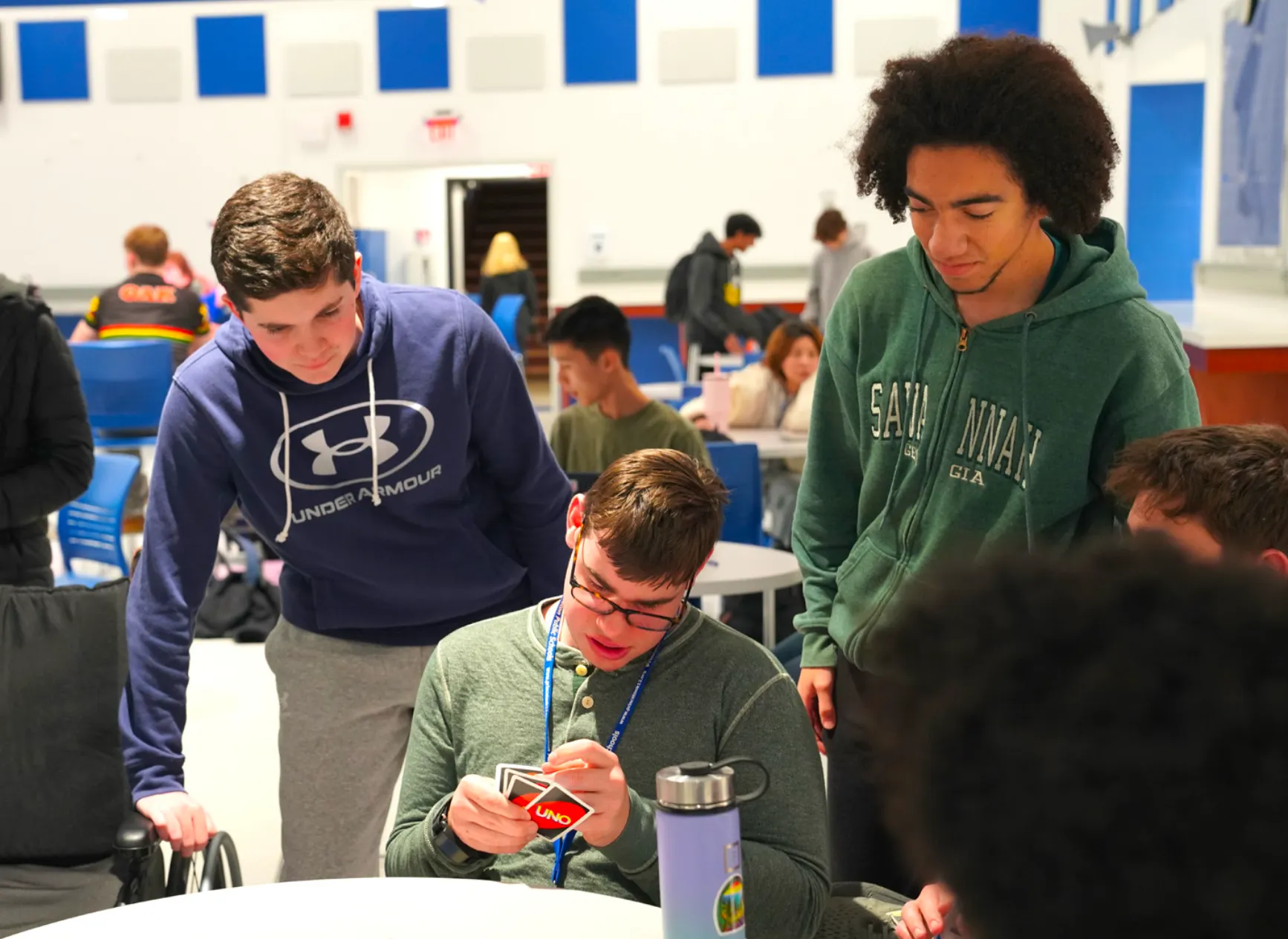
November 29, 2025 marked the 50th anniversary of the Individuals with Disabilities Education act, a landmark legal act issued by the U.S. government in 1975 that guaranteed children with disabilities received the proper services as part of free public education in the “least restrictive environment” (LRE).
“This anniversary reminds us that the road to educational rights was hard-won by families who refused to accept less. We honor their advocacy and recommit to protecting and strengthening these vital rights for all students,” said Margarita Baldeo, PHS Superintendent of Special Service.
PHS is home to nine special education programs, each designed to meet students’ individual needs. Though some of the offered programs are designed to accommodate academic challenges, others address developing life skills, such as the “School-to-Work” and “Adult Living” programs.
“In society, [special education students] have to conform to the expectations that are set for [them],” said Crystal Riddick, Supervisor of Special Education at PHS. “Instead of us setting the expectation that the kids have to meet, we need to meet the kids’ expectation by planning to support them.”
The process begins with the child study team, which is in charge of evaluation and classification of students who may be eligible for special education services.
“We get a referral that can come from a parent or the school or physician, and then we meet with the parents,” said PHS Social Worker Michelle Kotch, who is part of the Child Study Team. “If we determine that evaluations are warranted, that’s when we conduct the evaluations.”
Over 90 days, the team collaborates to create an Individualized Education Program (IEP), a legal document renewed every three years that provides recommendations for the type and level of special services that can be provided for the student.
“In PHS, we strive to ensure that we [have] an environment that’s least restrictive,” said Principal Cecilia Birge. “If you are a student with certain learning needs, we want to make sure that you are placed in an environment that gives you access to [a similar] curriculum [to] all other students.”
In order to do this, many PHS classrooms have In-Class Resource Programs (ICRP), where there are two teachers, one general education teacher and one Special Education teacher, who provide additional support to students with an IEP, and modify the curriculum to their level if needed.
“In an ICRP class, you might sit next to a student [or] some of your friends might have an IEP, and you don’t even [know] they’re receiving support,” said Riddick. “That’s the structure that we promote ... because kids should be inclusive and accepting of all students.”
PHS also offers resource classrooms for students with higher levels needs. These classes are taught by a Special Education teacher but retain many of the aspects of the standard curriculum. There are also classes that focus on teaching the core subjects with a focus on the development of real world skills.
“I don’t follow algebra, geometry, or anything for my LLD or my MD math,” said Danielle DeCroce, a Special Education teacher specialized in MD and LLD math, English, and social studies classes. “It’s all functional math skills — right now we’re working on coupons ... and saving money versus spending more.”
For students who require a supervising adult with them, PHS hires aides to stay with them throughout the day. Maurice Tigget has served as an aide in Princeton Public Schools for 12 years, prior to which he worked in a similar position at a residential facility for teenagers who have court orders.
“The ability to see the change and the growth in a student ... to watch them come in angry [with] whatever they got going on ... and see them and their mindset change, grow and they start to learn and understand ... is what makes this job wonderful,” said Tiggett.
In the case of Riddick, her passion for special education was rooted in her experience with her own child, who faced struggles receiving the same quality and level of education as his general education peers.
“It wasn’t that he couldn’t learn ... they [just] couldn’t meet his needs. That inspired me, once I got in[to] college ... I got into Special Education, and ... I found my purpose,” said Riddick. “When I say that, I smile ... my light bulb went off in Special Education, and I can’t see myself doing anything else.”
However, despite the wide range of services and accommodations that the special education program at PHS offers, many students still encounter gaps that the current system does not yet completely address.
“[There are some special education] students, who will probably never attain a driver’s license, [who] are being made to take driver’s ed,” said DeCroce. “I feel that there should be more adaptive classes, elective wise for them, [and] adaptive PE, where it’s just those kids with their peers. I think it would be more comfortable for them.”
But regardless of the program, a common theme shared amongst the various people in Special Education is to approach all students with understanding.
“You can’t force people to interact with all individuals, but I would just like to see people approach everyone with ... empathy,” said PHS Special Education and Autism Program teacher Jeremy Reilley. “Whether it be my students or just any other individual you see here at Princeton, have a little bit more empathy for each other. We’re all kind of trying to navigate this crazy world together.”