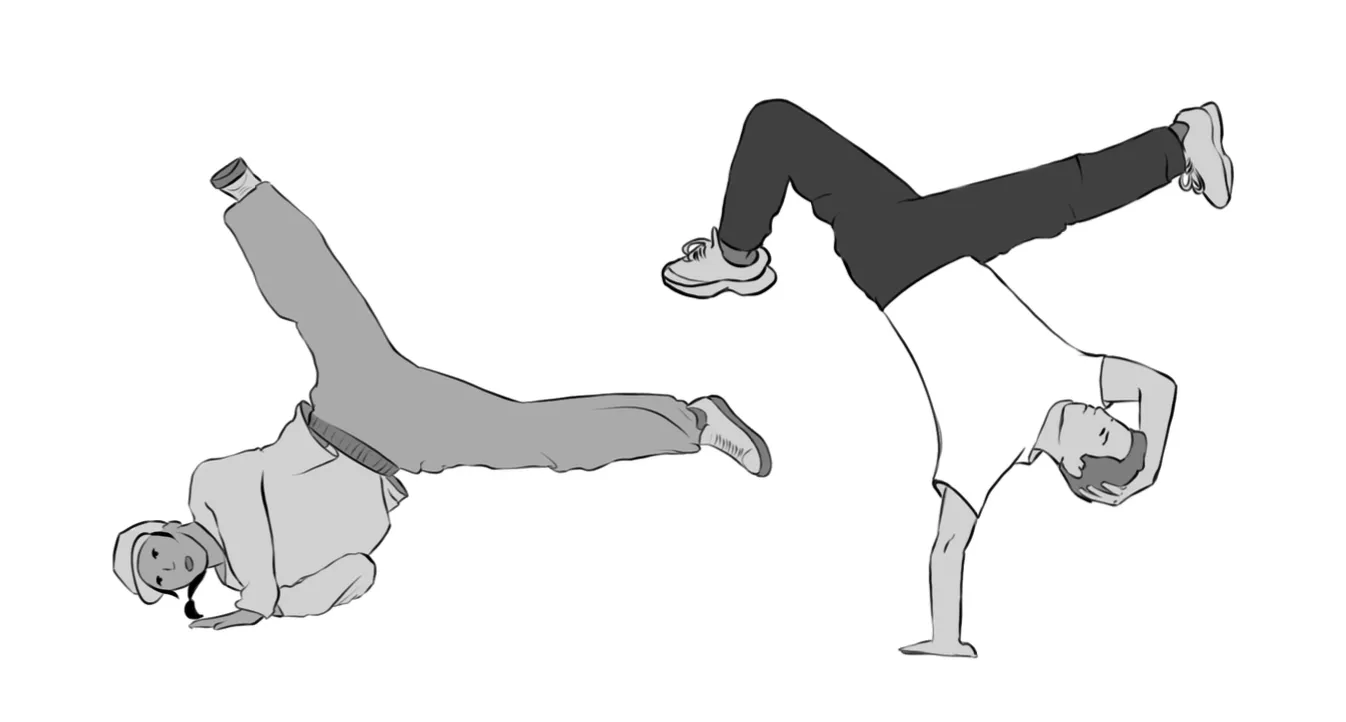
Breakdancing isn’t just spins, flips, and crazy footwork — it’s a cultural movement. Though breakdancing was created by Black American and Latino youths on the streets of New York City during the 1970s, this style of dance has now grown into a worldwide phenomenon.
Today, it shows up in music videos, competitions, and even the Olympics. Breakdancing made its first and only Olympic appearance in 2024, and has since then been removed from the Olympic catalogue of sports. Nonetheless, the Olympic debut remains a memorable moment for those who saw breakdancing as a sport more than an art.
“I think breakdancing is very impressive and entertaining to watch and requires lots of skill,” said Claire Hua ’27. “I was disappointed they took it off the Olympics because I liked watching it.”
With dance trends spreading through social media and school events, breakdancing cannot only be seen as a global art but also as a way of expression.
The art of breakdancing corresponded with the rise of hip hop. DJ Kool Herc, a Jamaican-American DJ and nicknamed the “Father of Hip-Hop,” founded it at the age of 18 in the Bronx. During extended instrumental drum breaks, breakdancers had a chance to display their skills in front of the crowd. Early breakers — the term for individuals who practice this form of dance — developed and created unique moves such as the top rock, six-step, and power spins. Later on, in the 1980s, breakdancing began to reach larger crowds as famous artists, including Michael Jackson, started performing it during concerts.
Over time, breakdancing has become more than just a dance, but a form of expression and rivalry between neighbourhoods. Crews and teams formed around the globe soon after battles in New York popularized. Even right now, the Pro Breaking Tour invites dancers from across the globe to compete in Los Angeles, California.
During the pandemic, it was announced that breakdancing would be at the 2024 Olympics, and breaking had a huge surge in popularity. Breaking competitions became popular over Zoom calls and facetimes between people. Lots of breaking studios held cheaper online classes so people could learn the sport and art of breaking. As a result, it became very popular and helped sustain breaking studios throughout the tough economy during the pandemic.
Recently, the Redbull Dance Competition was held in Los Angeles, where breaker JAIRA Joy took first place, defeating the previous champion, Waackxxxy, in the final. The Redbull Dance Competition is the world’s most respected dance competition, where individuals from all over the globe are brought together to share their creativity and talent. Breakdancing battles are not only judged through skill and power moves, but also taking into account musicality and originality.
“I think break dancing is very impressive. I respect it so much for those who can breakdance,” said Jessica Zhang ’26. “It’s very impressive and admirable to see how people can move and control their body in so many different ways to express certain feelings.”
Today, breakdancing continues to inspire and intrigue many of the youth, whether that be in schools or at home. Competitions, talent shows, and school events allow break dancers to show off their skills and creativity. What began as a street dance in the 1970s has now grown to become a form of art and expression for students who enjoy music, movements, and freedom to create their own style.