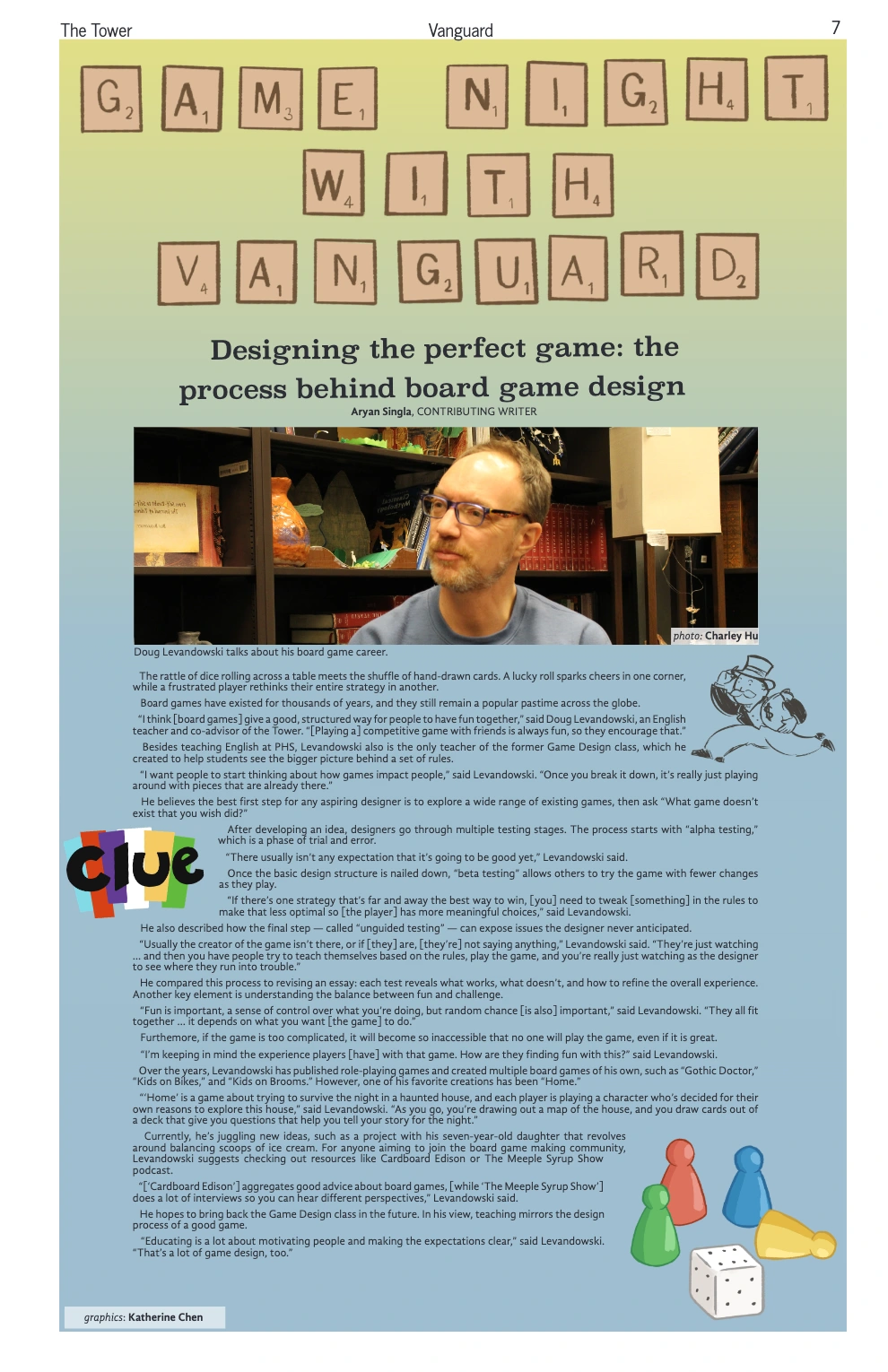
The rattle of dice rolling across a table meets the shuffle of hand-drawn cards. A lucky roll sparks cheers in one corner, while a frustrated player rethinks their entire strategy in another.
Board games have existed for thousands of years, and they still remain a popular pastime across the globe.
“I think [board games] give a good, structured way for people to have fun together,” said Doug Levandowski, an English teacher and co-advisor of the Tower. “[Playing] a competitive game with friends is always fun, so they encourage that.”
Besides teaching English at PHS, Levandowski also is the only teacher of the former Game Design class, which he created to help students see the bigger picture behind a set of rules.
“I want people to start thinking about how games impact people,” said Levandowski. “Once you break it down, it’s really just playing around with pieces that are already there.”
He believes the best first step for any aspiring designer is to explore a wide range of existing games, then ask “What game doesn’t exist that you wish did?”
After developing an idea, designers go through multiple testing stages. The process starts with “alpha testing,” which is a phase of trial and error.
“There usually isn’t any expectation that it’s going to be good yet,” Levandowski said.
Once the basic design structure is nailed down, “beta testing” allows others to try the game with fewer changes as they play.
“If there’s one strategy that’s far and away the best way to win, [you] need to tweak [something] in the rules to make that less optimal so [the player] has more meaningful choices,” said Levandowski.
He also described how the final step — called “unguided testing” — can expose issues the designer never anticipated.
“Usually the creator of the game isn’t there, or if [they] are, [they’re] not saying anything,” Levandowski said. “They’re just watching ... and then you have people try to teach themselves based on the rules, play the game, and you’re really just watching as the designer to see where they run into trouble.”
He compared this process to revising an essay: each test reveals what works, what doesn’t, and how to refine the overall experience. Another key element is understanding the balance between fun and challenge.
“Fun is important, a sense of control over what you’re doing, but random chance [is also] important,” said Levandowski. “They all fit together ... it depends on what you want [the game] to do.”
Furthermore, if the game is too complicated, it will become so inaccessible that no one will play the game, even if it is great.
“I’m keeping in mind the experience players [have] with that game. How are they finding fun with this?” said Levandowski.
Over the years, Levandowski has published role-playing games and created multiple board games of his own, such as “Gothic Doctor,” “Kids on Bikes,” and “Kids on Brooms.” However, one of his favorite creations has been “Home.”
“‘Home’ is a game about trying to survive the night in a haunted house, and each player is playing a character who’s decided for their own reasons to explore this house,” said Levandowski. “As you go, you’re drawing out a map of the house, and you draw cards out of a deck that give you questions that help you tell your story for the night.”
Currently, he’s juggling new ideas, such as a project with his seven-year-old daughter that revolves around balancing scoops of ice cream. For anyone aiming to join the board game making community, Levandowski suggests checking out resources like Cardboard Edison or The Meeple Syrup Show podcast.
“[‘Cardboard Edison’ aggregates good advice about board games, [while ‘The Meeple Syrup Show’] does a lot of interviews so you can hear different perspectives,” Levandowski said.
He hopes to bring back the Game Design class in the future. In his view, teaching mirrors the design process of a good game.
“Educating is a lot about motivating people and making the expectations clear,” said Levandowski. “That’s a lot of game design, too.”