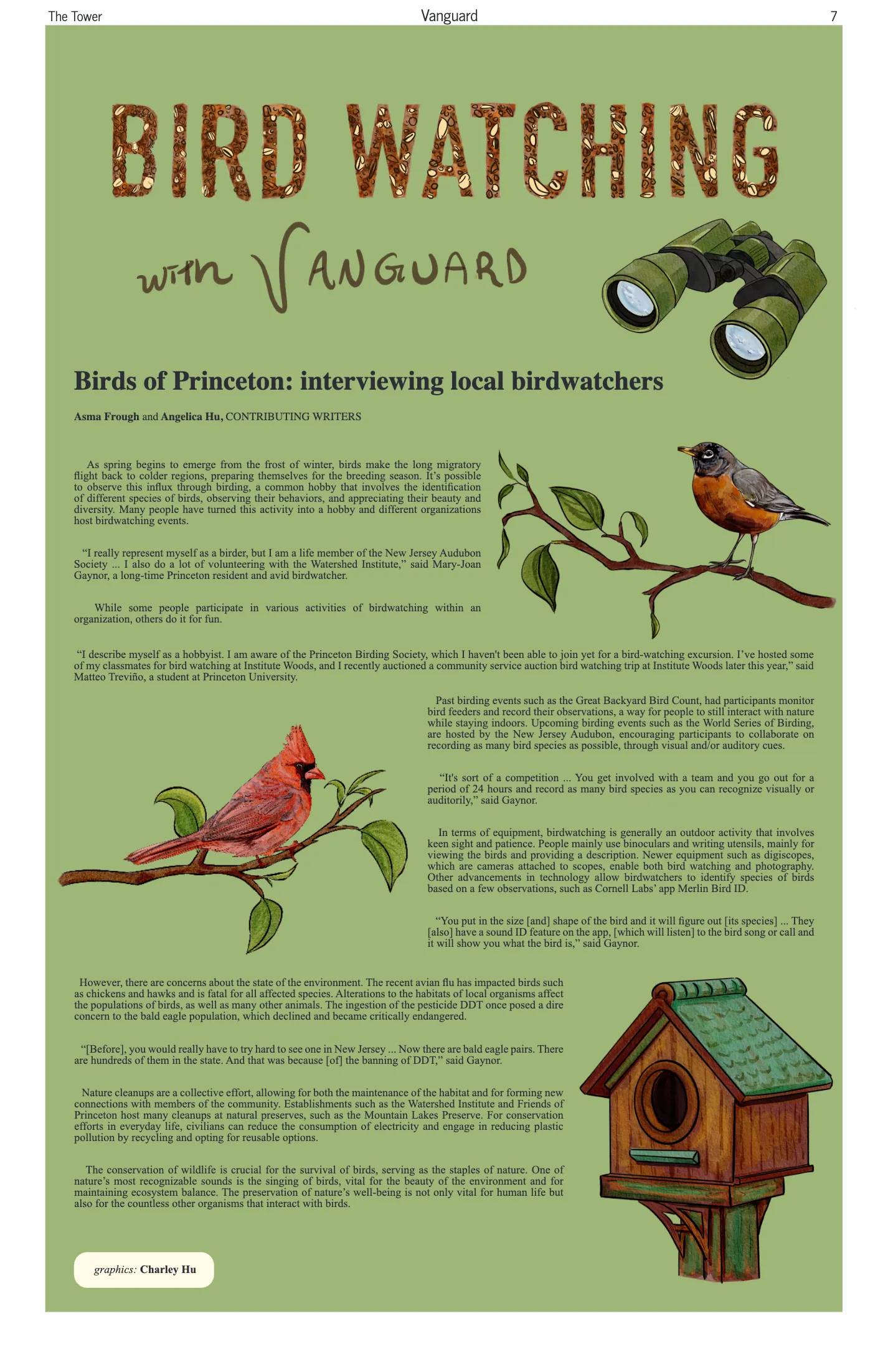
As spring begins to emerge from the frost of winter, birds make the long migratory flight back to colder regions, preparing themselves for the breeding season. It’s possible to observe this influx through birding, a common hobby that involves the identification of different species of birds, observing their behaviors, and appreciating their beauty and diversity. Many people have turned this activity into a hobby and different organizations host birdwatching events.
“I really represent myself as a birder, but I am a life member of the New Jersey Audubon Society. ... I also do a lot of volunteering with the Watershed Institute,” said Mary-Joan Gaynor, a long-time Princeton resident and avid birdwatcher.
While some people participate in various activities of birdwatching within an organization, others do it for fun.
“I describe myself as a hobbyist. I am aware of the Princeton Birding Society, which I haven’t been able to join yet for a bird-watching excursion. I’ve hosted some of my classmates for bird watching at Institute Woods, and I recently auctioned a community service auction bird watching trip at Institute Woods later this year,” said Matteo Treviño, a student at Princeton University.
Past birding events such as the Great Backyard Bird Count, had participants monitor bird feeders and record their observations, a way for people to still interact with nature while staying indoors. Upcoming birding events such as the World Series of Birding are hosted by the New Jersey Audubon, encouraging participants to collaborate on recording as many bird species as possible, through visual and/or auditory cues.
“It’s sort of a competition ... You get involved with a team and you go out for a period of 24 hours and record as many bird species as you can recognize visually or auditorily,” said Gaynor.
In terms of equipment, birdwatching is generally an outdoor activity that involves keeping a notepad, people mainly use binoculars and writing utensils, mainly for viewing the birds and providing a description. Newer equipment such as digiscopes, which are cameras attached to scopes, enable both bird watching and photography. Other advancements in technology allow birdwatchers to identify species of birds based on a few observations, such as Cornell Labs’ app Merlin Bird ID.
“You put in the size [and] shape of the bird and it will figure out [its species] ... They [also] have a sound ID feature on the app, [which will listen] to the bird song or call and it will show you what the bird is,” said Gaynor.
However, there are concerns about the state of the environment. The recent avian flu has impacted birds such as chickens and hawks and is fatal for all affected species. Alterations to the habitats of local organisms affect the populations of birds, as well as many other animals. The ingestion of the pesticide DDT once posed a dire concern to the bald eagle population, which declined and became critically endangered.
“[Before], you would really have to try hard to see one in New Jersey. ... Now there are bald eagle pairs. There are hundreds of them in the state. And that was because [of] the banning of DDT,” said Gaynor.
Nature cleanups are a collective effort, allowing for both the maintenance of the habitat and forming new connections with members of the community. Establishments such as the Watershed Institute and Friends of Princeton Open Space host many cleanups at natural preserves, such as the Mountain Lakes Preserve. For conservation efforts in everyday life, civilians can reduce the consumption of electricity and engage in reducing plastic pollution by recycling and opting for reusable options.
The conservation of wildlife is crucial for the survival of birds, serving as the staples of nature. One of nature’s most recognizable sounds is the singing of birds, vital for the beauty of the environment and for maintaining ecosystem balance. The preservation of nature’s well-being is not only vital for human life but also for the countless other organisms that interact with birds.