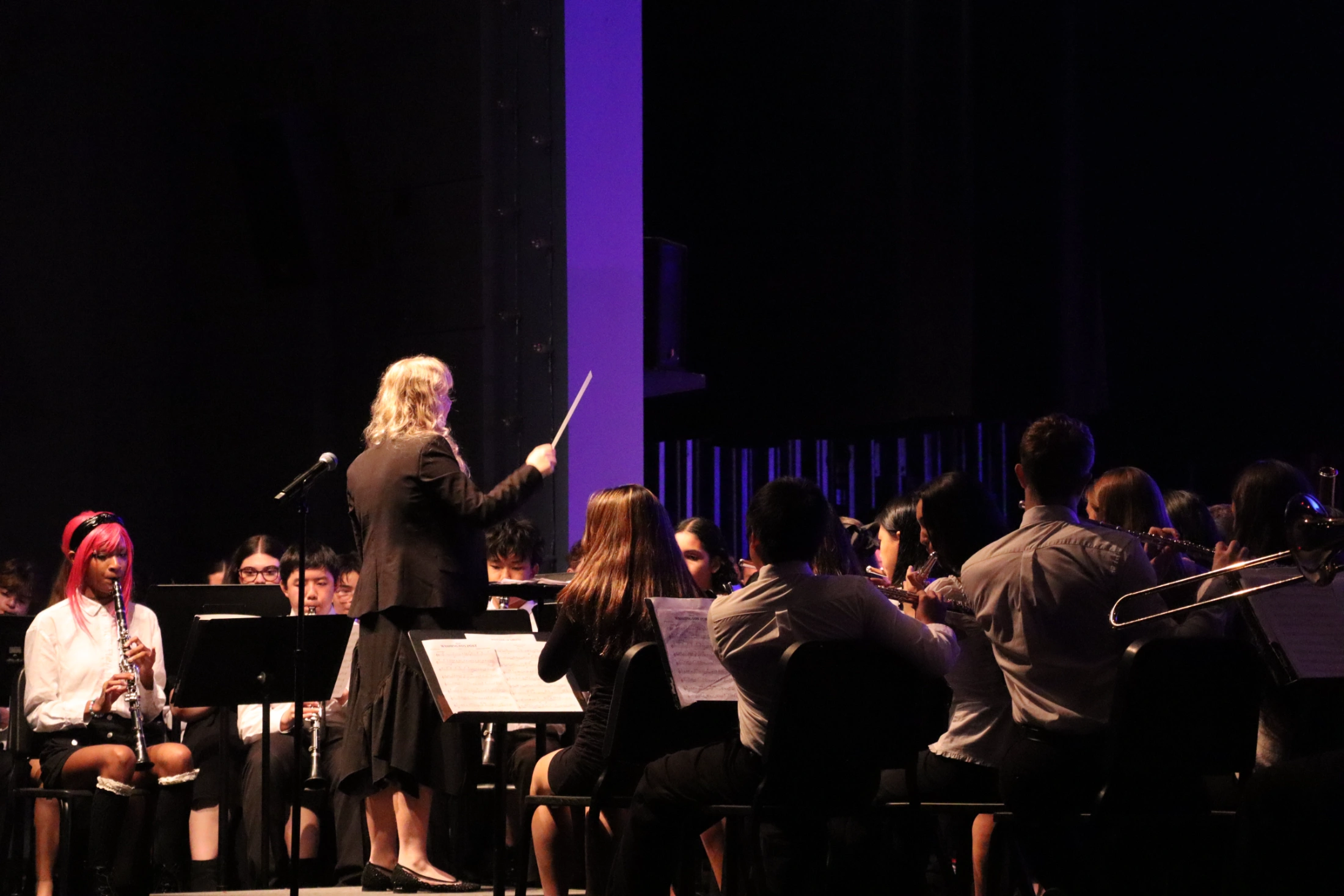
On October 14, in the PAC, the PHS band program performed its first concert of the 2026–27 school year. Though this concert is an annual tradition, this year they were joined for the first time by a student teacher from Princeton University.
This performance was the one time all year when every one of the bands united to perform together: Tiger I, Tiger II, Nassau I, Nassau II, Jazz Ensemble, and Studio Band. The various sections united to perform as a single Symphonic Band to open the concert, followed by a performance by Wind Ensemble.
“We never really get to see all of our students in one spot until we do this concert,” said band director Joe Bongiovi.
Audience members also got to see a new face up on the stage. Cassadie Royalty, a student teacher from the university, worked with the band members and conducted two pieces: “The Washington Post March” and “Ride.”
“This is my first time teaching high school. I’ve only been in elementary schools in the past,” said Royalty. “It’s been really interesting, because I get to have conversations with students [and] I get to play music [and] teach concepts that are more difficult.”
For the director, watching a guest conductor take over for a while was an opportunity to step back and observe the performance.
“It’s nice to hear all the work by somebody else actually conducting so we can hear the final product,” Bongiovi said. “Without worrying about every little thing, we get to hear the overall [performance].”
Playing together in such a large group presented many challenges, forcing students to adapt to working with more musicians than they usually do.
“You have to get used to ... the space [and] the dynamics and ... adjust to how many people are ... in each part,” said Mia Abrams-Sartor ’28.
Since the Symphonic Band includes musicians of different skill levels, the directors make sure to provide resources to encourage improvement.
“They give us so many things just to practice our knowledge on music,” said Nathan Ricciardi ’30, a clarinet player in the Nassau I section. “We do a lot of sightreading [of] songs. We’ll practice different sections of the piece that need the most work. We also have these drop-the-needle tests, which practice our knowledge of key signature, time, and different things so that we can get better at understanding.”
The most difficult piece, as many students told the Tower, was called “Ride” by Samuel L. Hazel.
“It is challenging for even the most experienced players, mainly because it’s so fast that all of us, even the highest bands, need to work on it,” said Ricciardi.
Despite this, many students said “Ride” is also the most enjoyable piece.
“‘Ride’ is the most fun composition to play because it’s fast-paced, keeps you on the edge of your seat, and I love the melody,” said Nassau I flutist Harnaksh Sandhu ’30.
Despite the many difficulties the students faced, the concert ultimately proved to be an opportunity for growth.
“The fact that [the concert] is that large allows students without confidence to gain confidence, because they’re sitting next to somebody who can play their part,” said Bongiovi. “And for those students who have confidence, it allows them to develop leadership skills to help the people who are struggling.”