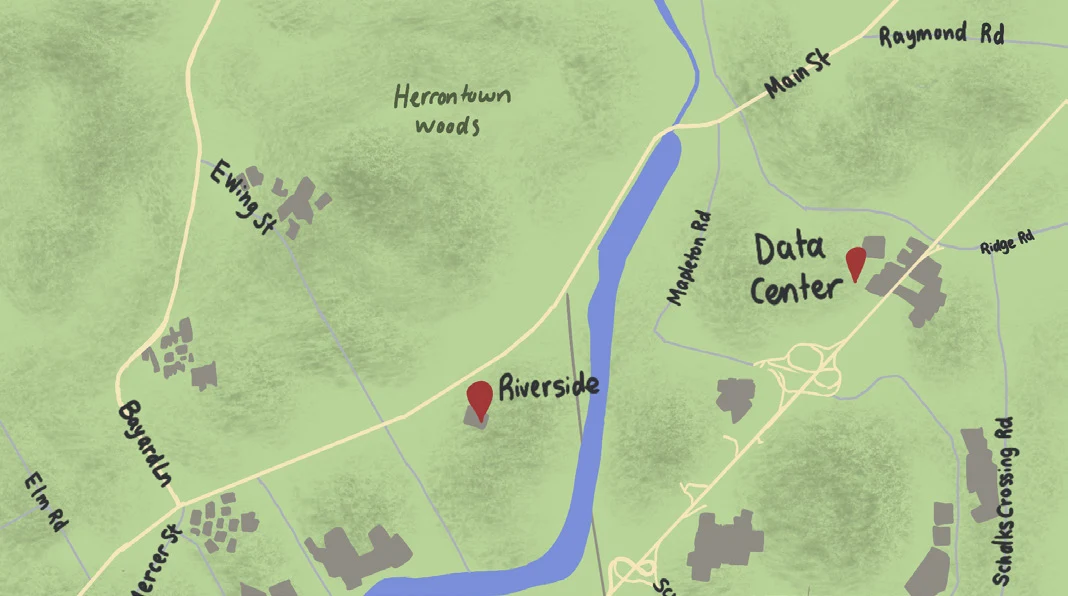
The construction of a 341,000-square foot data center approximately 4 miles or a 10-minute drive for Riverside Elementary school has ignited debate across South Brunswick, Princeton, and Kingston. Construction, led by Sentinel Data Centers, is expected to conclude by the end of this year. In recent months, however, opposition from residents in surrounding towns has grown – in light of the growing public backlash, the New Jersey Department of Environmental Protection extended the public comment period on the plan to November 9, 2026.
At the center of the public opposition is the air pollution permit issued from the New Jersey Department of Environmental Protection. Specifically, the site plans to install 20 large, diesel-powered generators and store an estimated 400,000 gallons of diesel on site.
While developers sought to classify the facility as a “minor source” of air pollution, this classification depends on the assumption that the diesel generators will be used solely for testing cycles of 28 hours per generator per year. Yet models for emergency operations and peak-demand running have not been made public.
“The 20 generators, misleadingly characterized as ‘minor sources’ of emissions, will run not only during power outages but also for routine testing and during periods of peak or critical demand,” wrote the Mayor and Town Council in a public statement issued on October 1.
Environmental reporter Carolyn Jones, who has reported on the development since February, noted that while the facility may meet minor source criteria on paper during maintenance drills, the reality tells a different story.
“These generators will be used in other scenarios, too, and we can’t tell you what the cumulative amount of emissions will be. But it’s very certain that it would be considered a major source of pollution,” said Jones.
Compounding the problem is a lack of local oversight in air pollution monitoring, so residents would not be able to track the level of pollution caused by these generators.
“There are only 29 air monitoring stations around New Jersey … the nearest one to us is Cape May,” said Jones. “There are no air quality monitors anywhere near us, so we wouldn’t even know when this stuff is blown into the air.”
Further adding to the friction is the lack of jurisdiction of surrounding towns on South Brunswick’s decision and approval making process, even though air pollution will travel across municipal borders.
“South Brunswick, they will get the tax benefits, but it’s Princeton, Plainsboro, Kingston, perhaps even as far as West Windsor, depending on which way the wind flows. They’ll be bearing any of the harms,” said Jones.
Chief among these harms are impacts on elementary schools throughout Princeton, specifically Riverside Elementary.
“When running, these generators will undoubtedly send emissions across municipal boundaries, often negatively affecting air quality and public health in Princeton’s residential neighborhoods and at two of our elementary schools,” wrote the Council and Mayor in their statement. Princeton Public Schools did not issue an official statement on the development but noted they are monitoring the developments.
The site was formerly home to Princeton Nurseries, once the largest commercial plant nursery in the United States. Christine Symington, Executive Director of Sustainable Princeton, highlighted the ecological reversal taking place on the land. She explained that the positive carbon sequestration effects from growing plants on the land will now be replaced by a property producing carbon emissions.
Symington also noted the pace at which the developments have moved forward has caught town officials by surprise.
“I don’t think towns or even the public really anticipated how fast things would move. Three years ago, would you have had the foresight to be like, ‘oh no, we got data centers [that] are going to start being built’. Three years ago, it was all warehouses.. and then very quickly, we’ve had to grapple with data centers,” said Symington.
The power imbalance between volunteer municipal boards and tech entities was also echoed by Jones.
“Local officials, up until now, have really been on the back foot when it comes to negotiating with these big data center developers, because these are large corporate developers. They have a lot of power... it’s such an imbalance between these local officials and these big corporations,” said Jones.
As the NJDEP reviews public comments on the air permit application, regional momentum continues to build. Several community organizations, including PHS Students for Animal Advocacy and Environmental Action, The Sierra Club of New Jersey, and the Climate Revolution Action Network have amped up efforts. Jones encouraged students passionate about the cause to make their voices heard by attending municipal planning meetings.
“Attend public meetings. I would say that’s especially powerful for students, because I’m not sure how often elected officials … get to hear from students, but I think it would be really valuable for them to go to all of these different meetings and express their concerns,” said Jones. “And, they could also write to Governor [Mikie] Sherrill.”