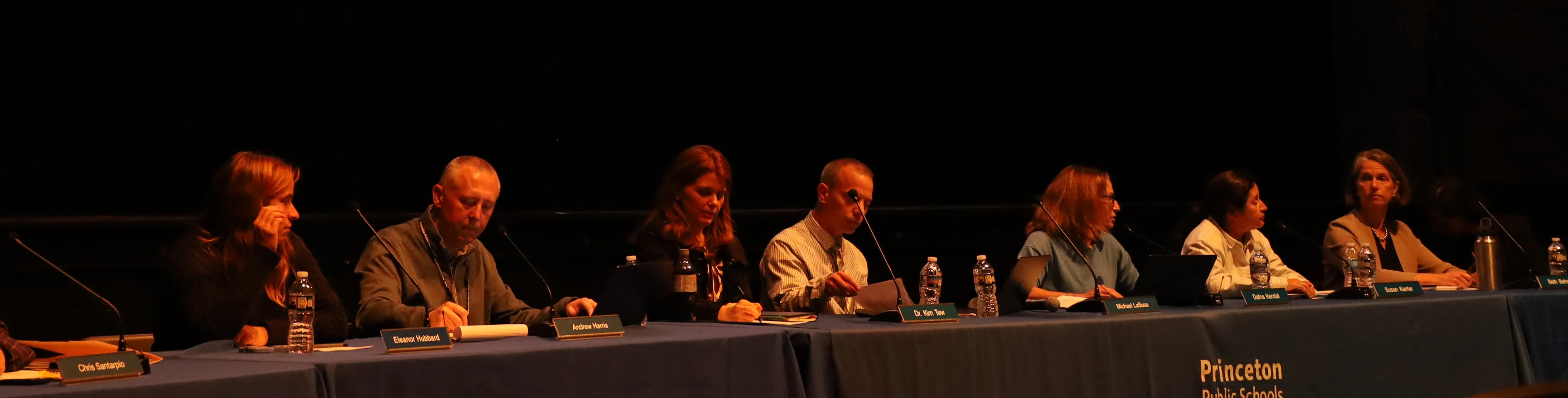
Princeton Public Schools superintendent Dr. Michael LaSusa proposed plans for the future of the Dual-Language Immersion (DLI) Program in the PPS district at the board meeting on October 27. Due to various concerns raised by staff, the district, and parents at Community Park (CP) Elementary School, LaSusa made recommendations to remake the current DLI program into a Spanish-Intensive program for the 2027–2028 school year.
The proposal suggests changes in the schedule—from teaching math and science with complete English instruction, to increasing the Spanish Language Arts class time from 30 to 45 minutes every day—aimed at encouraging explicit Spanish instruction to help students acquire a second language, rather than the dual immersion format CP has today. In addition to restructuring CP, LaSusa’s proposal also recommends increasing advanced Spanish instruction at PHS and adding Spanish social studies instruction to the middle school.
The process of deciding proposals for the future of the DLI program started in January of 2026. From January to June, the Board of Education (BOE) gathered data and opinions from staff at CP and parents attending the district through staff and faculty meetings and surveys. Common trends in DLI staff feedback cited burn out, deviation from original DLI goals, and hardship in providing appropriate math instruction for students.
“The teachers over time started to be really overloaded … there was a lot of work. … So [from the] perspective of the teachers, I understand that they needed more support, and they never got that support,” said Spanish teacher at PHS and previous DLI program instructional assistant Alessandra Clemens-Lores. “But the program itself, it could be such a gem … it just needs to be polished.”
DLI is a form of educational instruction done in two native languages. In this case, Princeton’s DLI program, started a decade ago at CP in 2014, set out to integrate 50 percent English instruction and 50 percent Spanish instruction throughout the school day. However, while DLI programs need to reach a threshold of providing equal amounts of instruction time in both languages, as of 2026, the CP DLI program provides an uneven split between the two languages. On average, as mentioned in the October board meeting, over 62 percent of instruction is in English, while only 38 percent of instruction is done in Spanish. Due to these measurements, LaSusa and CP staff members expressed concerns over program equity, as English continues to be more valued in teaching subjects like Math.
“We’re not aligned as a 50-50 program right now. … And that’s one of the reasons why teachers were sharing with me that the kids aren’t staying in the target language [Spanish],” said LaSusa during the board meeting. “I am recommending that we reimagine CP as a language intensive school and transition from what we’ve been calling a DLI program, even though we’re not meeting the threshold of 50-50 language, into a Spanish intensive program.”
Despite the uneven split of language instruction right now, immersion in Spanish culture and its application to other subjects has been viewed as invaluable to Princeton families. Due to the opportunities that CP provides for dual-immersion and language learning, many parents in Princeton have moved to the neighborhood in hopes of enrolling their children in CP. The parents of Milania Kapoor ’27, a senior who was part of the first cohort of DLI students at CP, relocated to Princeton to provide her the opportunity to learn with DLI.
“When my parents were growing up, their parents had to teach them Hindi, but then their teachers told them [that] would interfere with their English education, so they were never able to learn any other languages,” said Kapoor. “They wanted me to learn as many languages as possible, and to be able to learn different cultures. … They heard about this program, and so they moved here really just for the DLI.”
Similarly, many community members, who moved to Princeton for the program, whether it was in search of reclaiming Hispanic identities for their children through education, or in support of multilingualism, said the change to a Spanish-Intensive program would fail to incorporate the language immersion that they value.
“It’s a very clear difference. The Spanish intensive program is just advanced Spanish like in [the] high school. It’s just an extended block of AP Spanish, it’s not the same thing at all,” said sixth grader at Princeton Middle school and DLI student Ruya Choudatry. “In dual language immersion, you’re learning Spanish across multiple subjects. If you just have Spanish for 45 minutes, are they teaching your math … or science, and you just can’t really survive in the real world with that kind of knowledge in a different country.”
Furthermore, speakers also cited the inefficiency of the proposed intensive program, which reduces Spanish instruction from the original 122.5 minutes to 45 in promoting second language proficiency, a skill that many CP parents hope their students can learn during their 5 years in elementary school.
“Kids in elementary school are awake for a total of about 800 minutes per day. The new proposal is to have kids at CP learn Spanish for 45 minutes per day … that comes to about 5 to 6 percent of their total time,” said Princeton University Psychology professor Casey Lew-Williams, whose research focuses on language development and cognitive development in children. “According to science … kids need around at least 15-20 percent of exposure to each of their languages to achieve meaningful proficiency.”
Considering the impact of cancelling the DLI program, community members have implored the BoE to consider the impact it will have on not only current DLI students, but also the Princeton community as a whole. Clemens emphasized the significance of the DLI program for students throughout their lifetime, beyond just their primary and middle school education.
“Working in the elementary [school], now in the high school and seeing the advantage of the program, it’s unbelievable,” said Clemens. “You could see how much these kids were impacted … not only [were] they immersed in the language, but they also started to be curious about the culture. So many kids wanted to travel to different parts of the world to Peru [and] Ecuador. That is one of the benefits that they don’t see in the long run.”
While LaSusa acknowledged the positive experiences families have had with DLI, in addition to teacher workload and instructional equity, Lasusa emphasized the decreasing demographic representation in CP as an unintended consequence of the DLI program. While the inception of the program intended to reach diverse student groups, including multilingual learners (MLs), low income, special education, and African American students, the current demographic makeup of the school shows gaps in original representation goals.
“The whole idea of introducing the DLI program in CP [was] because there is a lot of Latino community there around it. Now, sadly, this community has been disappearing slowly … because of the prices of the house [and] because of what’s going on with ICE and all that, it’s disappeared,” said Clemens. “The demographic has changed.”
Since DLI’s inception a decade ago at CP, low income students have decreased from 20.9 to 16.8 percent, MLs 10 to 5.1 percent, special education students from 16.8 to 10.3 percent, and African American students from 6.7 to 4.1 percent. Compared to other elementary schools in the district, CP is the school with majority white students, lowest percentage of black students. The concern over low equitable access to the DLI program added to the belief from LaSusa that the current operation of the DLI program isn’t fulfilling the education goals of the original plan.
In order to operate the Spanish-Intensive program next year, the district is planning to hire two certified teachers of Spanish or bilingual education, allocate one to two more classrooms dedicated solely to Spanish instruction, and the conversion of CP back to a community school, rather than the opt-in and opt-out system that families can choose now. According to PPS Board of Education member Dafna Kendal, specific action and voting over the initiative will be taken at the next board meeting. Before the BOE decides concrete plans, students are advocating for a different solution presented by staff and parents in the district, rather than replacing the DLI program as a whole.
“Hearing that they’re going to be cutting down on the immersion doesn’t seem like the right way to go for me,” said Hazel Fitzgerald ’29, a DLI student who was inspired to start her own non-profit for cleaner water in Ecuador after her experience learning Spanish in Princeton. “I think that if they’re finding issues in the Spanish program then the way to approach that is not to cut down on the level of Spanish involved in that program. It [is] to improve the quality of Spanish education that the students are getting.”