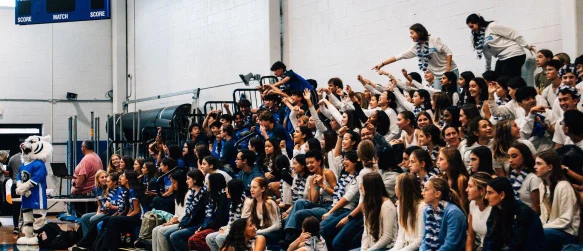
Debates regarding “school spirit” are typically predicated on how an individual defines the term. While some people may envision a Friday Night Lights style of school spirit, characterized by large marching bands, full bleachers, and packed excitement at a football game, this definition is not necessarily uniform. Around 34.5 percent of PHS students reported wanting a “little more” school spirit at PHS, while 26.4 percent wanted a “lot more” according to a survey released by the Tower in early October. This survey, conducted during gym classses, was part of an independent investigation that aimed to determine how students and staff feel about school spirit at PHS. However, according to Dean of Students Diana Lygas, school spirit at PHS is found in components of the school beyond those generally considered as part of “spirit”.
“We have 144 clubs … [in addition to] bands, choir, arts … [and] 20 or so community service projects that are led by students. … I think all those areas where people are finding their passion at school and committing their time to doing it, and doing it really well, feel that sense of pride, belonging, and community is what school spirit is about,” said Lygas. “I feel like there’s definitely no shortage of school spirit when I think of it as belonging, and [having a] sense of community in our school.”
While data from this year’s student council elections were not yet available, Lygas shared conclusions from the 2025–2026 election cycle that were reportedly consistent with general voting trends of recent school years. Voting results, which determine each year’s student council, impacts the planning and execution of events focused on school spirit.
“There was a 45-ish percent voter turnout for the class elections. The … class of 2029 had a really strong voter turnout. … Consistently, the most voters are ninth graders and 12th graders,” Lygas said.
This tendency for freshmen and seniors to dominate school-spirited activities was echoed by Student Council Advisor Alana Smith.
“Mostly because [seniors] know how to work within the school, you’ve seen other classes do things, you know what to be excited about, whereas freshmen …[don’t know as much]. So probably familiarity with the school culture as well,” said Smith.
Some students, including PHS Cheer Team Captain Simone Henriques ’28, feel that a modern, academically-focused PHS culture inhibits a traditional sense of school spirit and fun.
“My parents went [to PHS] and their high school experience was so much different than my high school experience. … My parents always talk about how sports used to be fun. Everybody would want to come to watch a lot of football games,” said Henriques. “[Now] it’s dry, especially when we have home games, nobody goes, nobody wants to dress up.”
Henriques later added that the best way to achieve stronger school spirit is to unite and come out to support each other as a student body, in all the competitive activities that attend to all sections of the student body enjoy, not just athletics.
“I think we all need to be there for everybody,” said Henriques. “I just think that school spirit goes a long way and I think the first step is supporting each other and everything, even if it’s a math thing: ‘I don’t really like math, but I’ll come and support you because you’re a part of my school.’”
Varsity athlete Ben Kahn ’27 felt that even though PHS does not foster a traditional form of school pride, sports are a prevailing interest for PHS students. He asserted that the inability to hold sporting events at night, such as homecoming, partially limits school spirit.
While the homecoming game has taken place at night under rented lights in previous years, budget cuts prevented it from taking place this year, as the game was played at 2:00 p.m. on Saturday, October 17, a rescheduled date caused by poor weather on the original date.
“We [have] had homecoming [at night], and obviously this year that no longer happened, and I think that definitely takes a hit on the school spirit,” said Kahn. “But I think that people should continue to care about sports ... even in [a] school where academics take priority; [sports] is an integral part of our community and should be treated as such.”
PHS has not been able to invest in permanent lights on the athletic fields due to concerns raised by nearby Princeton residents. According to PHS Principal Cecilia Birge, ticket prices could not be raised to offset the costs of a nighttime game, estimated at about $26,000, due to logistical county regulations.
“This year was a really tough budget year, … so we are cutting left and right, trying to squeeze out a lot of inefficiencies in the building,” said Birge. “My secretary got cut, the support person in the library got cut, so we are assigning multiple functions to [a] smaller number of people now, and for athletics, transportation is by far the most expensive. … And so in order to save money, [the lights were] one of the things [to go].”
Students may have noticed that the accompanying homecoming dance was missing from the festivities this year. As explained by former student council advisor Jennifer Li, declining interest in the dance and scheduling conflicts led to the council’s decision to focus on alternative activities this year in place of the event. Li further elaborated on how the decline of the homecoming dance is just one indicator of what was, in her opinion, a fractured PHS school spirit.
“Homecoming dance started up again a few years back, and it got pretty big because a lot of the [underclassmen] were excited for it, and then they got to be old upperclassmen, and now they’re just like ‘Oh, we’re too cool for that, we’re doing our own thing,’” said Li. “Having upperclassmen stay excited for things, and having more things geared for the seniors or juniors will make it so that they continue to stay excited for it from freshman to senior year, rather than dying off once you’re older and have more independence.”