On social media, 2026 has been declared “the new 2016” in terms of fashion trends, music, and viral challenges. Our attitude toward feminism, however, has regressed far further backwards, erasing the strides made by “the girlboss era.”
Society has proved its love for extremes time and time again: rather than finding a middle ground when it tired of corporate feminism — the ideal of defining liberation through career success — it landed on the opposite side of the spectrum. Recently, the “tradwife” trend has gained huge amounts of popularity on social media platforms and in pop culture.
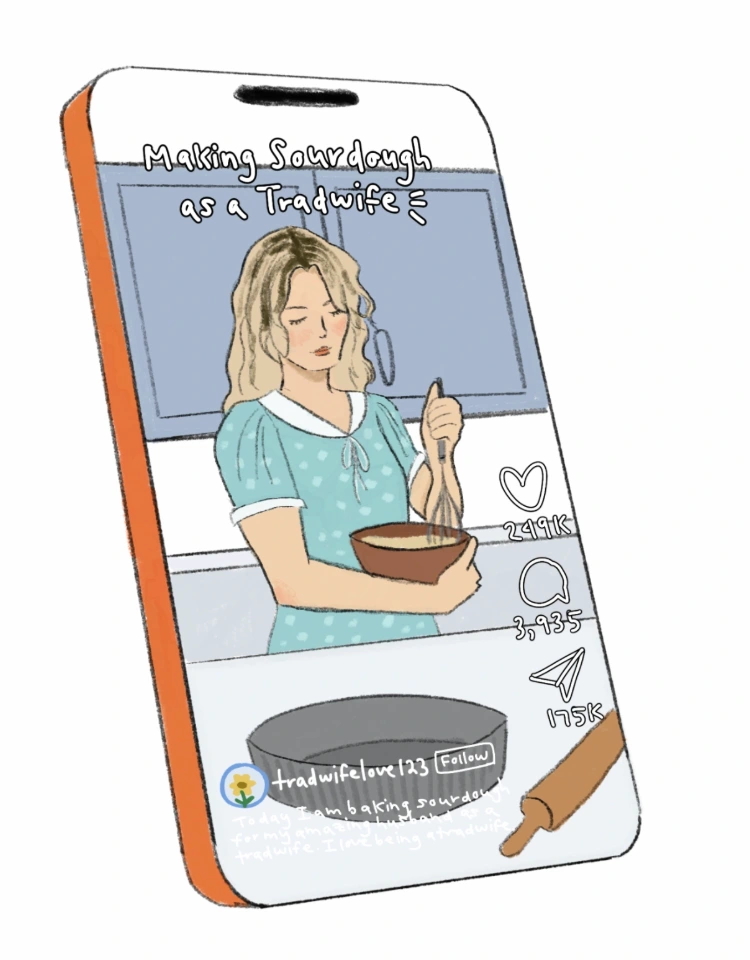
Short for “traditional wife,” the trend features a return to a mid-century aesthetic: clean houses, vintage dresses, homemade baking, and traditional family roles. While framed as an innocent aesthetic by many, at its core, the tradwife trend is a symbol of a deeper cultural stagnation — one that risks years of hard-won gender equality and could dramatically shift younger generations’ approach to gender roles.
The tradwife trend has manifested in various ways, primarily through social media posts of artificially curated lifestyles. Influencers like Savannah Stone embody the extreme extent to which the trend can reach. She promotes submission to husbands by preaching that a woman should belong to him and that women should not have the right to vote. Using TikTok, Instagram, and podcasts, Stone has actively influenced how many young people view feminism, marriage, and career expectations. Other influencers share more subtle approaches to the trend, focusing primarily on the aesthetic side of it. Some of these women even completely reject the tradwife label, while remaining the personification of the idea.
Whether intentional or not, even these more nuanced takes on the tradwife trend have serious implications for how we as a society approach feminism. The reality is that we cannot fully support a lifestyle as simply “an aesthetic” when it has been intertwined with sexist ideas for centuries. On top of that, these influencers fail to recognize a key detail of the idea: in today’s society, the tradwife lifestyle is no longer truly attainable. Influencers that either directly or indirectly support the trend are backed by extreme wealth derived from the commercialization of their lifestyles, not a single standard income, which is the reality for most housewives.
Not only does the spread of “tradwife-ism” pose a huge threat to the idea of feminism as a whole, it also puts the tradwife herself in a dangerous position. A pillar of the ideology is complete economic dependency on one’s husband. But then, what would happen in the case of divorce, death, or abuse? Though the idea of both getting divorced or being widowed seems unlikely at the start of a marriage, according to the U.S. Census Bureau, almost half of all marriages end in divorce, and one million women are widowed every year. In an unhappy marriage, the tradwife is left with two options: divorce her husband and lose her sole source of income and financial support, or remain miserable, submitting to a husband she despises.
Or worse, what if this husband was abusive? National Domestic Violence Hotline data reveals that one in four women will experience severe physical abuse from an intimate partner. And the primary risk factor for abuse? Asymmetrical power in relationships. Relationship vulnerability is only one of the many possible risks of dependency. If a woman’s husband dies, she is left out to dry. An NIH study found that nearly half of all widows experience a decline in quality of life in the first year after their husband’s death. When a woman has no source of her own income, the effects of this are even more severe. If a woman builds her whole life on her reliance on and submission to her husband, she loses her purpose without him. This is not to say that women should not have agency over their own lifestyles, though. In fact, the point of feminism is giving women the freedom to design their own lives. The problem arises when women are pressured into leading lifestyles that are falsely advertised.
Although this trend is so harmful, many men view it as a positive thing for society. A King’s College study found that Gen Z men are now twice as likely as Baby Boomer men to hold traditional views on marriage roles. It also found that 59 percent of Gen Z men believe that society has expected men to do too much to support equality. Tyson Gordon, a 31-year-old former contestant on the TV show Married at First Sight, asserted that the tradwife movement isn’t sexist and he doesn’t want to “put his wife on a leash,” he just wants her to have “time for herself.”
But a study published in the Psychology of Women journal found the exact opposite. Researchers assumed that a baseline level of benevolent sexism — an attitude against women that appears polite but reinforces traditional gender roles — would be present in these men. However, they found that men who viewed the tradwife system favorably had even higher levels of hostile sexism: a blatant negative, adversarial attitude toward women. These men often diminished the women’s contribution to a traditional marriage, claiming that caretaking and child-rearing were easier than their “actual” work.
So why is Gen Z still so obsessed with the tradwife movement? The answer lies in corporate burnout and the rise of right-wing ideologies pushed by social media. A WebMD study found a 23 percent increase in persistent, chronic burnout in US employees from 2022 to 2026. Men who feel that they’ve lost all power over their lives are being convinced that if they had a traditional marriage, they could finally take control of something: a woman. The women, meanwhile, are craving an escape from the endless corporate cycle, longing for something that seems simpler and more fulfilling. When a high school girl is scrolling through TikTok and sees a woman baking cookies in a sunlit kitchen, her brain views it as an escape from the relentless social and academic pressures weighing her down.
While maybe not as obvious at PHS, young women around the world are forgoing opportunities in pursuit of a utopian vision that is almost always unachievable, and puts both individual women and the concept of feminism as a whole at risk. The influencers are only the vessel of the tradwife message, though. The real blame lies with our regressive society that forces vulnerable women into the same boxes they spent so many years escaping.