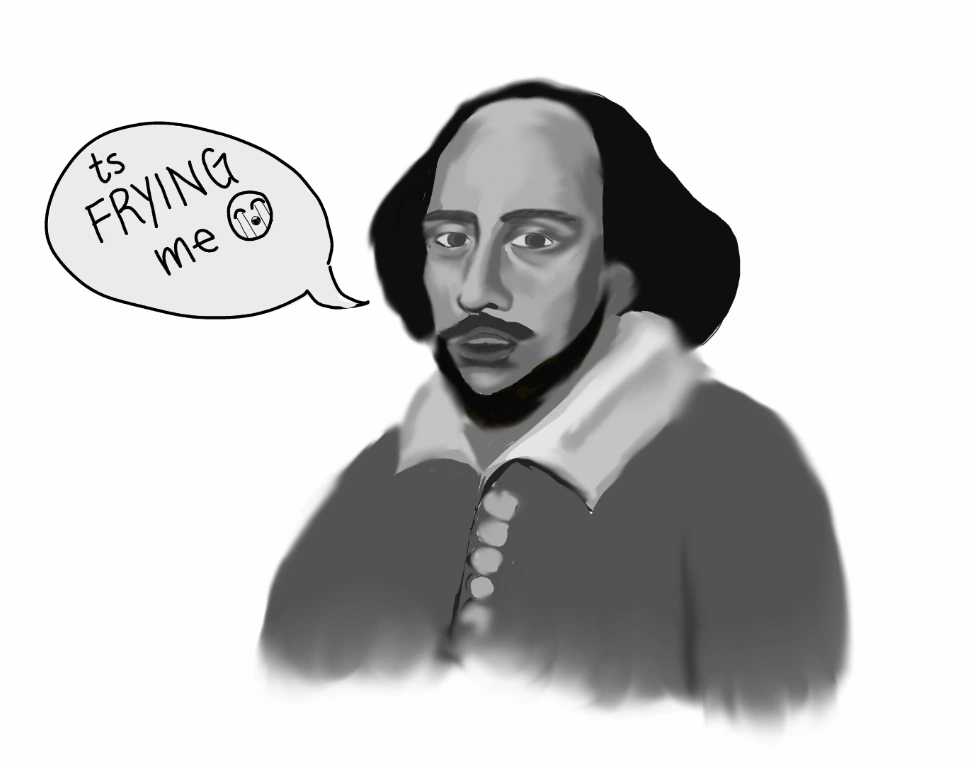
Consider, for a moment, why that title grabbed your attention. It sticks out from the stiff formality of a newspaper, and it wouldn’t be surprising if this is the first time you’ve ever seen an emoji in print. Hopefully, among the sea of authors on these pages, my name is one that you trust a little more now. Linguists would call that establishing an ingroup, and as the name suggests, you and I are in the group! The people who don’t understand what it means to be fried by two emojis are members of the outgroup.
We all establish ingroups on a regular basis to signal exclusivity, and generations as a whole have been doing this since the beginning of humanity. It is, in fact, why slang exists and evolves so rapidly. We as the younger generation want to ensure our uniqueness to the older generations, and so we use words they can’t parse. Once they do, and your teacher starts saying “six seven” in class, we move on to something new. That way, we stay special and develop our own culture.
But it’s starting to get tiring. No generation has ever been able to communicate as fast as our generation can, and that means that we replace slang faster than anyone else ever has. To keep up with the constantly shifting ingroup, we too must constantly shift, or we risk falling behind. Of course, this does sound a little silly: how impactful is it really to not know who Tung Tung Tung Sahur is? But the whole point of the system is to exclude those who do not know the vernacular; the culture builds from there. Unfortunately, the faster slang evolves, the harder it is to keep up with. Not scrolling for a few days could mean waking up to all of your friends making a reference you don’t get, laughing and finding solace in, inadvertently, excluding you.
Previously, ingroups used to be simple things. You would say “Hasta la vista, baby,” and everyone would know you’ve seen Terminator II. They’d ask you how you liked the movie and you’d get into a fight over whether the character development was exciting. With personalized algorithms, one person will mention how rain beads off their Arc’teryx jackets and another will point to a smiley face and say, “Verity!” We don’t see the same things anymore and that makes those cafeteria connections harder. I want to be able to join a conversation from a quote I hear, but I can’t do that if the ingroup is so small and personalized that I don’t know the quote. It’s hard to pick out one fish from a sea of culture.
We now drift along fluviatile currents of nano-groups rather than riding the oceanic waves of monoculture, and it creates disconnect. The paradox of ingroups is creating inclusivity through exclusivity, but the system we use to build connections instead ends up fracturing us. We must remember what the goal of slang is; we have reached the point where rather than using words to determine who is fried, we must fry them ourselves to build a bridge.
We’re not the first to search for common ground. “Which way does your beard point tonight?” Allen Ginsberg asked Walt Whitman, roaming through a supermarket in 1955. He was looking for a shared identity, something that he could point to and say: “We come from this.” Instead, he found a closing time. We scroll through supermarkets, with shelves stocked differently for each customer, passing each other in aisles with carts full of references others do not understand; no one will guide us to a product we cannot find.
Before closing time comes, lead someone to the aisle you’re in.