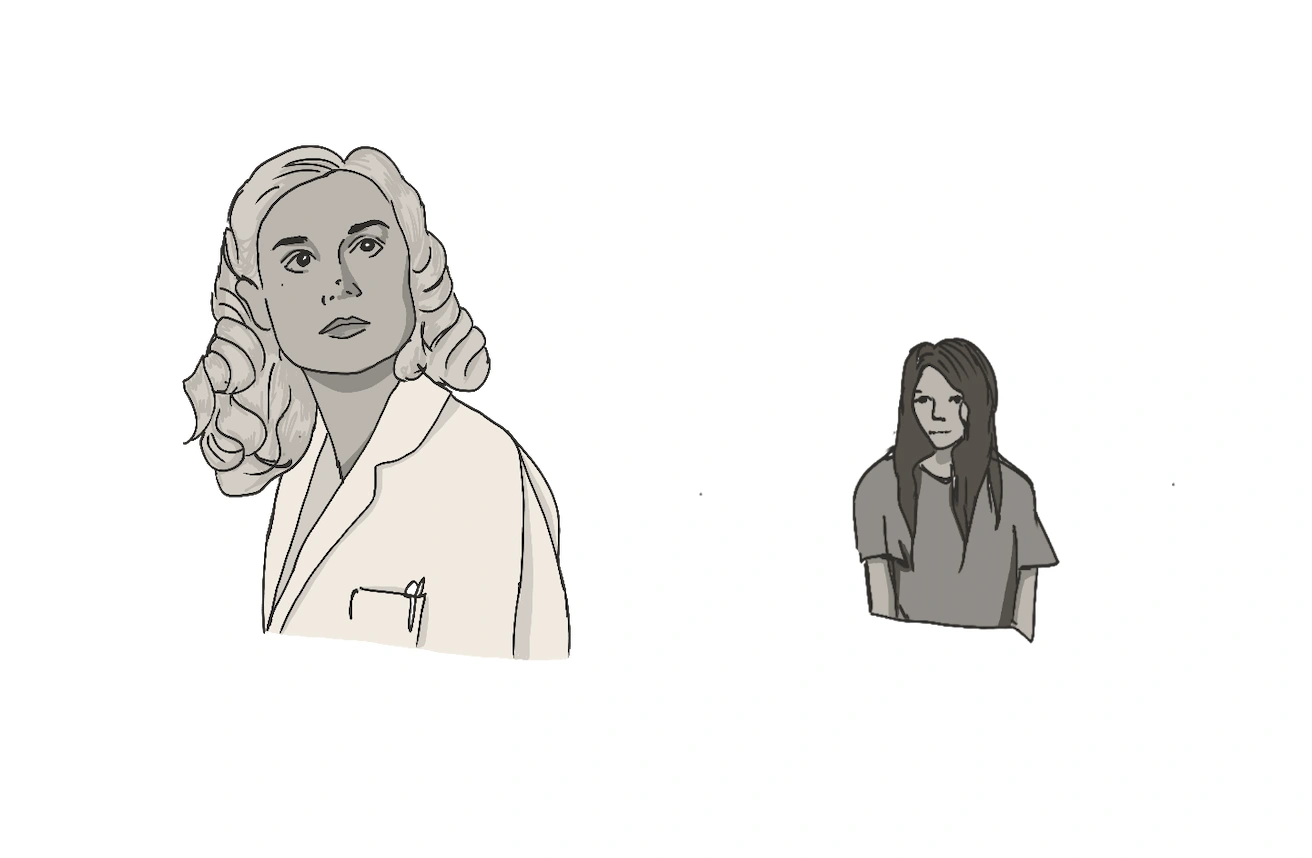
“Lessons in Chemistry”
Being a woman in the 1950s and 60s was already hard enough. As author Bonnie Garmus explores in “Lessons in Chemistry,” women were often expected to devote themselves entirely to their husbands. If they did not, they frequently faced financial ruin, lost the chance to have children while staying accepted, and endured severe social degradation solely for attempting to live independently. Garmus's protagonist, Elizabeth Zott, said otherwise.
In “Lessons in Chemistry,” Zott is determined to become an established scientist at Hastings Research Institute. However, the rigid societal norms of the 1950s and 60s prevent her from doing so. Throughout her entire career, she faces sexual harassment, assault, and intellectual theft from coworkers and bosses. After having a child out of wedlock, her dreams become even harder to achieve. To make ends meet, Zott reluctantly accepts a job hosting a cooking show called “Supper at Six." Her down-to-earth personality rejects the glamorous housewife stereotype, allowing her to connect with the millions of women who watch the show. Zott points out the intense labor that managing a household requires and teaches cooking as a complex chemical process, proving women are not only capable of science but use it in their everyday lives. By doing this, she encourages viewers to rethink their worth and challenge the status quo. Zott closes every episode with her iconic and powerful phrase, “Children, set the table. Your mother needs a moment to herself.”
Garmus does an excellent job of highlighting the clear irony of the era. If women aren’t smart, why did Zott’s boss feel the need to steal her work? If male scientists claim to be entirely dedicated to logic, facts, and objective analysis, why do they weaponize their power to assault female coworkers? From beginning to end, you will find yourself rooting for Zott. Reading this book in a time where sexism is less prevalent, it seems obvious how wrong things were back then. In the first half of the novel, it feels like Zott is the only woman who has a modern perspective on sexism in the mid-20th century. However, after seeing the reactions of the women watching “Supper at Six," it is revealed that almost every woman feels the same. Zott has a true scientific mentality, and she refuses to understand or accept men’s illogical sexism.
This book is the perfect read for Thanksgiving break, as it is traditionally a time for reflection and gratitude. Read “Lessons in Chemistry” as a way to feel educated about the past and grateful for the progress women have made and continue to make. We should be thankful for the women who fought for equality so that future generations of women could live independently. This Thanksgiving, use the kitchen as a place of empowerment and connection, just as Zott did on her cooking show.
Reading the novel while partaking in holiday festivities, like gathering in the kitchen to prepare for a feast, gives it an extra layer of relevance. Instead of treating the kitchen as a space defined by traditional gender roles, Zott reminds us that cooking is chemistry — an act of science, precision, and creation. By referring to salt as sodium chloride, she strips the kitchen of patriarchal expectations, treating women working in it as skilled scientists rather than servants. Over a break centered around a massive family feast, this book invites readers to look at labor happening in the kitchen not as a submissive traditional role, but as a demonstration of shared power, talent, and intellect.
“The Silent Patient”
Taking place in modern-day London, “The Silent Patient” by Alex Michaelides is a psychological thriller about a famous painter named Alicia Berenson who has fatally shot her husband Gabriel five times in the face. Gabriel’s death is the catalyst of the entire story; after his murder, Alicia refuses to speak a word to the police, the courts, or her family, turning the tragedy into a very public mystery.
Although Michaelides has a background in studying psychotherapy and working in mental health settings, it seems as though he chose drama over accuracy. The narrator, Theo Faber, is a criminal psychotherapist. He credits Alicia’s trauma and severe mental illness to a very obvious problem: Alicia’s troubled relationship with her father. This severely undermines the complexity of mental illness; the book is set up as a medical mystery, but then Michaelides ultimately resorts to the explanation that Alicia is just a broken adult, whose actions are inevitable, and are solely a result of childhood trauma. What was the purpose of Theo's agonizingly slow, intricate research into this mystery, if the grand explanation for Alicia’s actions could have been easily diagnosed? From my perspective, the plot has so much wasted potential. Instead of utilizing the middle of the book to build genuine psychological tension, the narrative stalls for hundreds of pages only to deliver a lazy, oversimplified resolution.
Despite winning multiple awards such as the Goodreads Best Mystery & Thriller in 2019 for its compelling concept and final twist, "The Silent Patient" seems to be hit or miss with readers. Personally, I found that it starts incredibly strong, with good writing and an immediate hook. However, because the novel is so heavily structured around its climax at the end, everything between the first and last 50 pages feels sluggish and stagnant. After hearing all the hype surrounding this book, it felt underwhelming that the climax was so anticlimactic.
Furthermore, an excessive amount of red herrings were added, distracting from the main plot. Theo went down rabbit holes, trying to find the root of Alicia’s psychological trauma. I felt that this was unnecessary, as it made the plot harder to follow, creating numerous lies and backstories that did not add anything of real substance to the mystery.
If you are someone who doesn’t mind Michaelides's priority for drama in lieu of psychological depth, The Silent Patient is a great read for Thanksgiving break when people find themselves with a lot of free time. This is the type of book that must be read quickly in order to keep your interest. It is an addictive, binge-worthy mystery that you can tear through before the break is over.