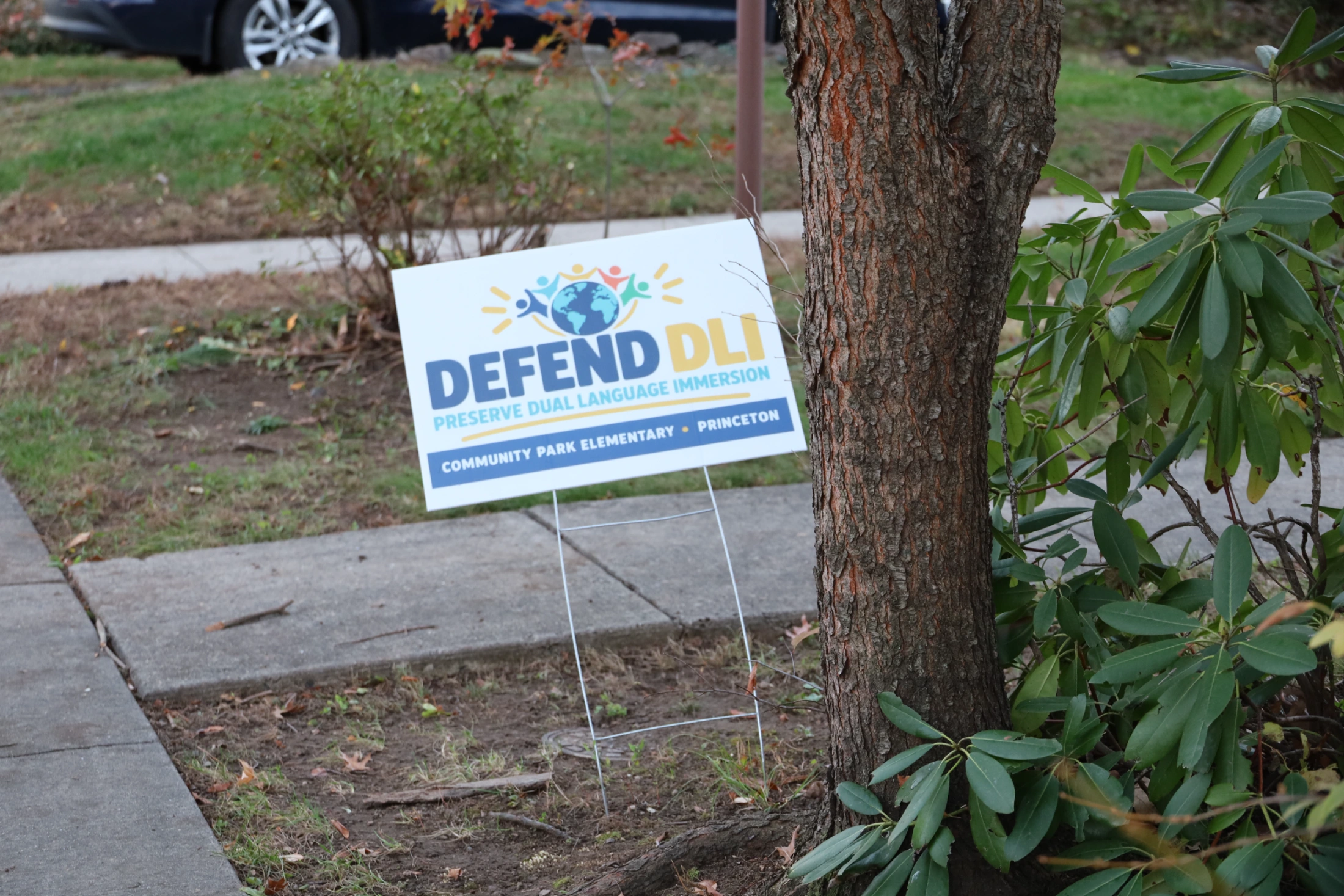
On November 17, the Princeton Public Schools Board of Education unanimously voted to end the Dual Language Immersion (DLI) program for the 2027–2028 school year. The termination of the DLI program, proposed by Superintendent Dr. Michael LaSusa, aims to transform DLI into a Spanish-intensive program. His plan includes reducing the total number of minutes of Spanish instruction at Community Park (CP) Elementary School, adding more advanced Spanish classes to the PHS curriculum, and removing the opt-in/opt-out option for the DLI program for families in the CP neighborhood.
The mission of DLI was to create immersive Spanish education. Previously, the program involved 122.5 minutes of daily Spanish instruction, including 30 minutes of Spanish Language Arts (LA) and 60 minutes of math alongside science and daily routines. Teachers at CP have expressed concerns about students struggling to understand math instruction when taught in Spanish, and as a result, have often reverted to teaching in English. Thus, LaSusa proposed adding 15 minutes to Spanish LA and having math and science taught entirely in English, which eliminates the midday classroom switch for students and teachers.
DLI students at CP were significantly less proficient in both math and ELA on the NJSLA from 2024–2026 than the other three PPS elementary schools. Only 10.34 percent of higher income and 12.00 percent of low income students were testing proficient in ELA. In math, 2.94 percent of higher income and no low income students were testing proficient. Those in the general education program scored much closer to the average.
However, some students are worried about the effectiveness of this change, arguing that Spanish math instruction was beneficial.
“We had to try and figure out how to solve math equations in Spanish,” said former DLI student Alex Wayne ’29. “It really made you understand the concepts that we took on way more efficiently.”
Students have also stated that the program has helped them move through high school Spanish and pick up other languages at a faster pace with less struggle.
“My general language skills are way better,” said former DLI student and daughter of DLI teacher Adam Blejwas, Sophie Blejwas ’28. “I don’t think I would have been able to make it to AP [Spanish] if I didn’t have the support that I’ve had from DLI since kindergarten. Since I’m also taking other languages in high school, I have better strategies for approaching problems when I don’t understand something or I have a question.”
Beyond the classroom, parents have also questioned how the program’s elimination will affect district-wide bilingualism, especially after voters approved a $89.1 million construction referendum in 2025 that included expanding CP to accommodate both DLI and neighborhood opt-out students.
“It’s removing so many opportunities from all students in the Princeton School District,” said Ellen Blejwas, Sophie Blejwas’ mother. “[PPS] can do so much better.”
Other students have also echoed these concerns about less language growth and lost cultural connection.
“[DLI] pushes everyone academically, it pushes us all to be better people, to meet new people, and to just experience new cultures,” said Jasper Clayton ’28, a former DLI student. “And I think that now kids are getting that opportunity taken away from them, it’s really sad.”
Along with the removal of DLI, administrators are proposing the expansion of the Spanish curriculum at the high school beyond the AP level, raising further concerns.
“I don’t really see the point of adding more advanced classes if they’re gonna get rid of DLI, because DLI is one of the programs which is helping people get to those [advanced] levels,” said former DLI student Judah Lerman ’29.
LaSusa has noted that Princeton Middle School will maintain its advanced Spanish courses to help bridge elementary graduates into upper-level high school courses. LaSusa pointed out that the schedule operates on a 62 percent English to 38 percent Spanish split rather than an exact 50–50 model, and under the new plan, CP students will receive 788 hours of Spanish across K–5, which is nearly four times the 210 hours currently offered at other Princeton’s elementary schools. He argued that having more time dedicated to Spanish LA can provide a better grammar and mechanics framework for K–5 students.
“There could be great value in [the proposed program] because it’s so keenly focused,” said Community Park Principal Dineen Gruchacz. “We’re only teaching Spanish for the sake of teaching Spanish [language] and culture, as opposed to ‘I’m teaching you this math curriculum and this math content, but I’m doing it in this other language and hoping that it all comes together and then ultimately transfers.’”
According to LaSusa, this system also hurts non-native English speakers, preventing them from building skills for future learning.
“[Some] CP students ... don’t already possess a deep and rich vocabulary in English because they’re learning English for the first time, or because they don’t have as much English at home,” said LaSusa. “[They are] not acquiring as much of the vocabulary and the foundation in English and math as they might need to be [in order to be as] successful as they can be when they get to middle school.”
The DLI program also complicates things for families with multiple children: CP doesn’t allow students to begin the program starting in grades past kindergarten.
“If I have a kindergartner and a second grader, the second grader is not allowed to attend CP [for DLI]. They have to go to another school because they haven’t had Spanish kindergarten, first grade, so that’s not fair,” said LaSusa.
The district considered the importance of instructional clarity over the benefits of complete immersion. After consideration, all Board of Education voting members from Princeton unanimously voted to end the 11-year program at the Board Meeting on Tuesday, November 17. The transition will take effect in the 2027–2028 school year, permanently changing how Princeton students experience Spanish language learning and immersion from elementary school through graduation.