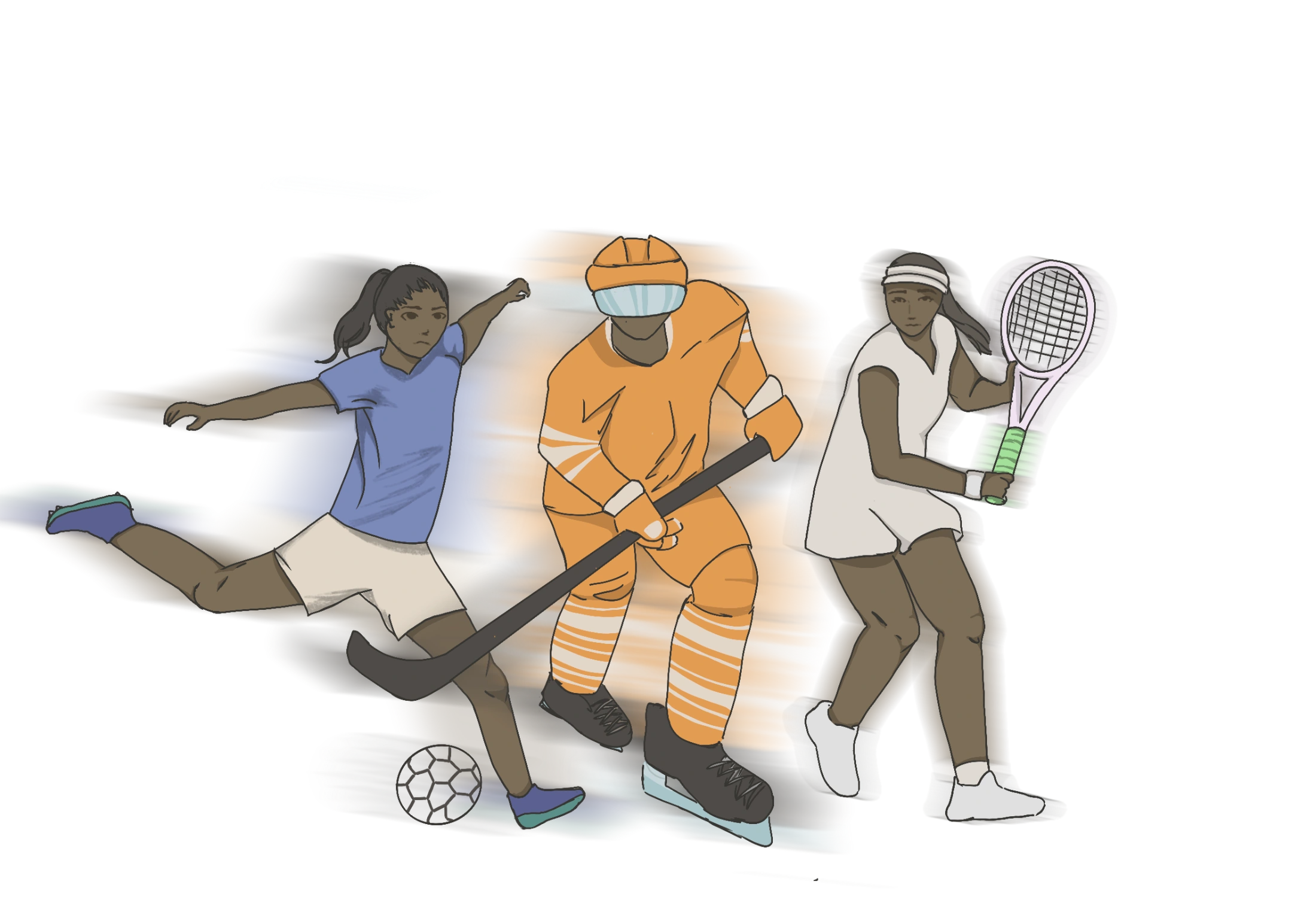
The sharp scrape of skates against ice gives way to the thud of cleats on grass. A hockey stick is put away, and a lacrosse stick takes its place. For many student-athletes at Princeton High School, the end of one season marks the beginning of another. Each season gives athletes a chance to learn new skills, connect with teammates, and grow through different experiences.
One way playing multiple sports builds adaptability is by developing physical skills that can transfer between activities. Different sports require athletes to use their body in varying ways, which allows them to build skills that might not be developed through a single sport. Maeve Hughes ’29, who participates in cheerleading, ice hockey, and lacrosse, and previously field hockey, has experienced these benefits.
“A lot of my stick skills transferred from [lacrosse and field hockey] into ice hockey, like dodging and carrying the puck or the ball,” said Hughes.
On the other hand, specialization in a single sport from an early age might also carry certain risks.
“If you specialize in a sport too early, your muscles will get accustomed to one thing and that can lead to more injuries,” said physical education teacher Dominic Capuano.
Switching sports can also challenge athletes to adjust their mindset and find new sources of motivation. Aria Sloan ’30, who participates in rowing and has experience in cross country, volleyball, and rock climbing, found that the transition from cross country to rowing changed the way she approaches competition.
“Having other sports gives you different competition,” said Sloan. “In rowing, I’m excited to [compete] because I’m excited to try to do as best as I can and push my limit, and that wasn’t something I had in cross country.”
Moving between sports also means adapting to different team environments. Some activities place greater responsibility on individual athletes, while others require participants to coordinate closely with teammates. Capuano believes experiencing both types of competition can help students respond to different challenges.
“Certain sports are more individualistic, while certain sports are team-based, and you learn how to cope with different challenges,” said Capuano.
Indeed, Sloan’s experience highlights these benefits: cross country required her to motivate herself while running, whereas rowing challenged her to carry that self-discipline into a team setting.
“You have to self-motivate [in cross country],” said Sloan. “[That mindset] has definitely translated to the boat.”
Ruhi Zhou ’30, who plays both indoor and beach volleyball, has experienced a similar adjustment. While indoor volleyball involves a larger team, beach volleyball requires the player to communicate and coordinate closely with one partner.
“It’s more about the connection you have with your teammate [in beach volleyball],” said Zhou.
Through these different experiences, athletes have learned playing multiple sports is about developing a wider range of athletic skills, while each transition requires student-athletes to adjust to new skills, finding different forms of motivation, and to work with different team environments. As they move from one season to the next, they carry these experiences with them, building the adaptability to take on challenges both within and beyond their sports.