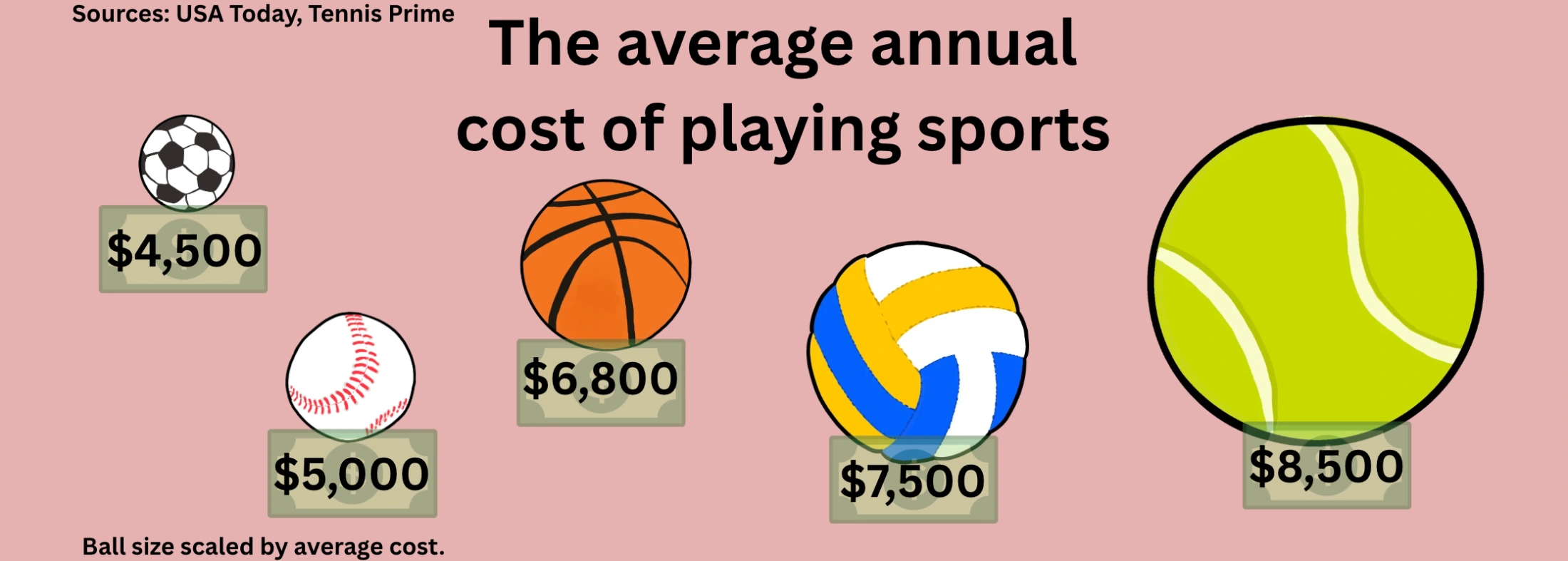
Thousands of dollars spent on equipment, traveling, and club fees can prove to be a major obstacle for young athletes trying to succeed in their sport. Financial costs also differ between sports, especially between individual and team based sports, which can limit the number of options available for a young athlete.
Although most sports have costs associated with them, not every household is equally impacted by the expense of playing sports. According to a 2021 study by the National Library of Medicine, lower income parents were more worried about the expenses of sports such as transportation and participation fees as opposed to higher income parents. Despite the financial challenges, many parents feel that having their child participate and stay active through sports is worth the expense because of the physical and mental benefits.
Every game, competition, and practice has expenses that can add up quickly. Although certain sports only require basic gear, many others call for expensive equipment, constant travel, and coaching. Sports such as tennis, ice hockey, lacrosse, and golf cost significantly more than other sports because of private lessons, limited facilities, and tournament fees. This can alienate lower income families from registering their children in these sports.
“Your most expensive costs are probably going to be your lamé, especially if you get a custom made, your electric jacket, your shoes, fencing shoes do run you quite a bit, as well as your blade,” said PHS fencer Rachel Kim ’29.
Among swimmers, a large portion of the expenses comes from the time and resources necessary to participate in the sport. Practice equipment, as well as goggles and high quality race suits, can significantly increase the overall cost. Club swimmers frequently have to cover the cost of travel to meets, in addition to meeting competition entry expenses. For club swimmer Clementine Nieman ’30, costs for swimming start with prices of attending regular practices and meet entry fees.
“For [me], the main expensive things are meet entries because you have to pay for each race,” said Nieman. “Just paying for practices is really expensive.”
As an athlete progresses in their sport, the cost of participating in the sport increases significantly. Oftentimes, when junior athletes reach an elite level, they face heavy costs for national tournament travel, better coaching, frequent equipment replacements, and facility rentals for extra practice. These added costs can discourage talented athletes who are succeeding in their sport.
Becoming a successful athlete is more than simply being measured by victories or losses. Between costly equipment, competition fees, and every small charge in between, the future of many athletes is outside of their own grasp.