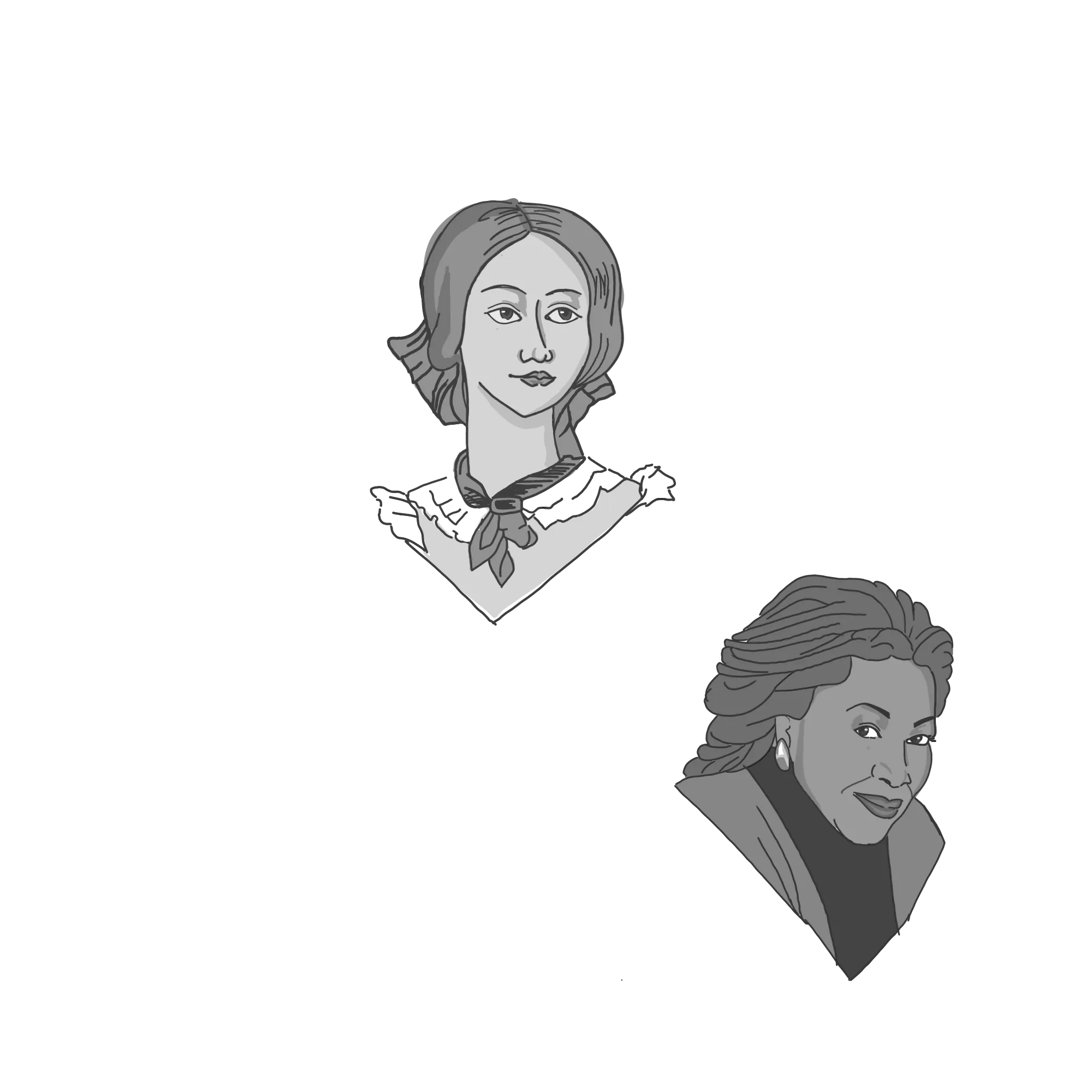
Beloved
The house at 124 Bluestone Road is haunted. Everyone in the bleak, post-Civil War Cincinnati, Ohio of Toni Morrison’s “Beloved” knows it, and all but a select few avoid it. The ghost of an infant rages against the home’s inhabitants, “worrying [the] house into evil,” but not only that; each member of the house, only a few years free from enslavement, carries with them the malevolent spirits of their pasts.
There are few books that characterize a period in American history better than “Beloved,” published in 1987 but set in post-Civil War America. It follows Sethe, an escaped slave, and her daughter, Denver, whose home in Ohio is haunted by the malevolent ghost of Sethe’s dead infant. When a mysterious woman referred to only as Beloved arrives and begins to worm her way into the two women’s lives, unbidden memories begin to surface, and Sethe is forced to reckon with the atrocities of her past. “Beloved” is the story of a deeply complex female character who possesses not only a great capacity for love but also for violence, exploring the vast impacts of slavery on the human psyche through the vessel of the family.
Diving into the minds of people who have undergone some of the most brutal abuse imaginable is not easy, and Morrison doesn’t hold her punches. Sethe, a strikingly complicated and tragic figure, is a mother of four children, which shapes her identity and the abuse she encounters at the hands of her enslavers. The story of her escape from slavery while pregnant, recounted several times throughout the novel, is visceral; the description of the whipping scars that looked like “a chokecherry tree,” “red and split wide open, full of sap,” is only one of its many striking images.
As is appropriate for a novel about ghosts and trauma, “Beloved” is heavily concerned with the issue of memory. The past is revealed in small, recursive snippets of flashback from various perspectives; all of the characters forget or block out major aspects of the core events, making it difficult to piece together the full picture of what transpired. This nonlinearity may hinder a new reader’s ability to follow the plot, but it shapes the story’s atmosphere: “Beloved” is a ghost story, eerie and dreamlike, and the unconventional form makes it a reading experience like no other.
Though Morrison’s novel is set almost two centuries ago, many of the issues it examines are still relevant today. Learning not only the way that slavery in America affected women then but also the way that its psychological scars linger in America today is crucial to understanding women’s history in the United States.
Jane Eyre
In 1846, Charlotte Brontë began to write “Jane Eyre.” She was 30 years old, and up to this point, most of her life had been spent moving from boarding school to boarding school, first as a student and then as a teacher. In this regard, “Jane Eyre” reads much like a narrative about Brontë’s own life: first an orphan living with her distant family, Jane is sent to an oppressive boarding school, where she eventually gets a job upon graduating, finally ending up working as a governess. Furthermore, in an event likely inspired by the death of Brontë’s older sister, Jane witnesses the aftermath of a typhus epidemic at her school, including the death of her closest friend.
Despite these parallels, however, and the novel’s original subtitle of “An Autobiography,” “Jane Eyre” is undoubtedly a work of fiction. Although it was published in the 19th century, it contains many of the modern novel’s conventions: a major reason for its popularity at the time of publication was its intense first-person narrative, unusual at the time but commonplace now.
As the governess for a young French girl at an estate called Thornfield Hall, Jane is drawn to the mysterious master of the house, Mr. Rochester. Inspired by the Byronic heroes Brontë read about in her youth, he quickly sweeps Jane off her feet. Trouble ensues, however, when strange occurrences begin to happen at Thornfield Hall, and Jane learns of the secrets he has been keeping.
Although a modern eye may not peg “Jane Eyre” as a radically feminist text — Jane never manages to break free from the societal expectations of a Victorian woman — many core beliefs of modern feminism are present in their prototypical forms. When Rochester proposes, Jane refuses to accept until he admits that she is his “equal” as a “free human being with independent will.” Brontë published “Jane Eyre” under a pseudonym, Currer Bell, in the hope that a more masculine name would help her succeed in the literary world. This proved wildly successful, and she was met with immediate fame. Though our society may have grown past strict Victorian ideas of gender roles, it remains important to read books by female authors — not just this March, but year-round.