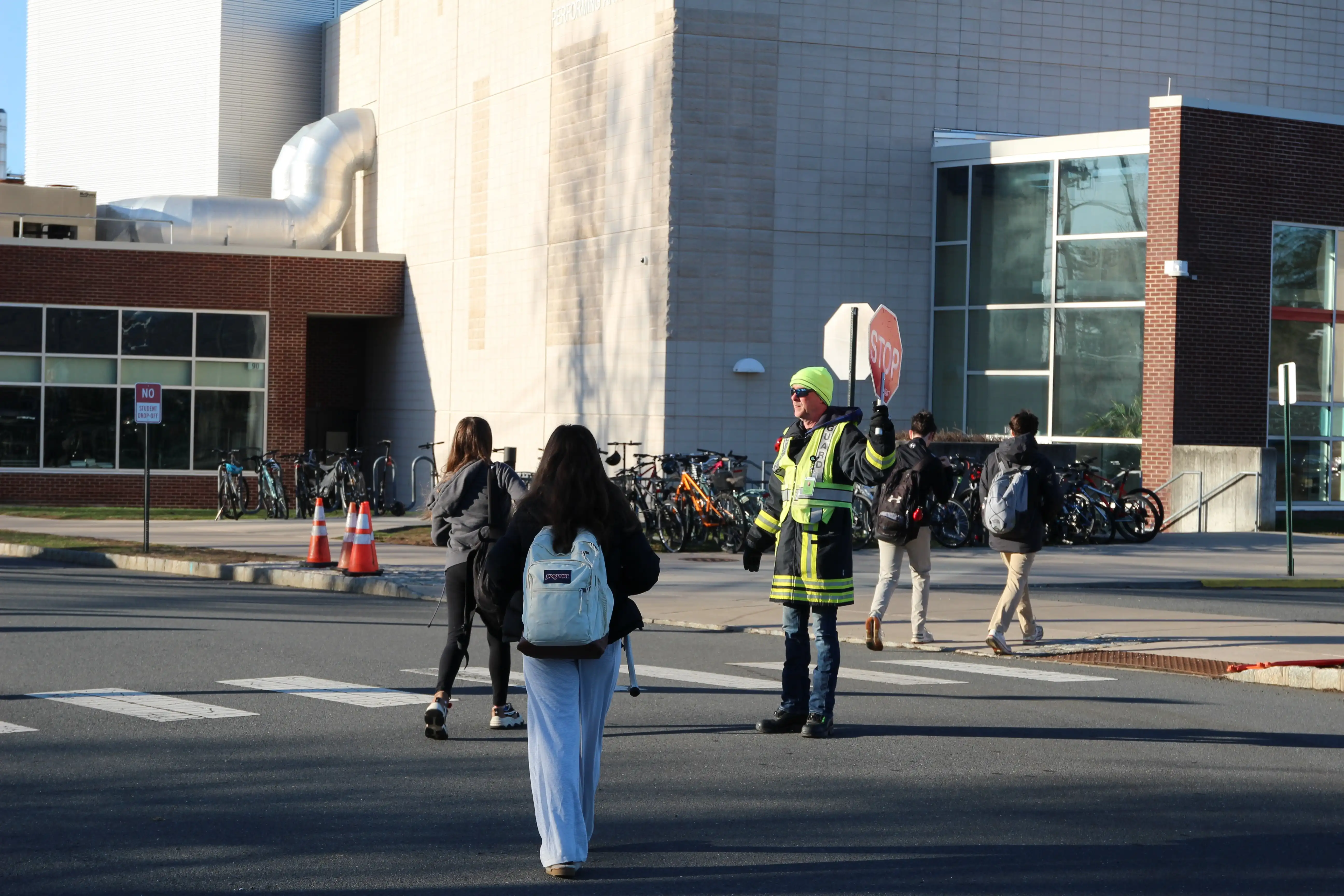
When it comes to commuting to school, visiting town, or simply enjoying the greater Princeton area, many choose to walk and bike. In fact, according to the PPS School Travel Survey, 16.1 percent of students choose to walk to school, and 14.8 percent bike. The Princeton Police Department and Princeton PTO enforce rules that aim to ensure the safety of all Princetonians, regardless of their transportation choice, with one of the main ways being stationing crossing guards in student-heavy intersections.
“Within [a] perimeter of the school, we [have] crossing guards right on school property, then [there are] crossing guard[s] out even further beyond the school property … blocks away, [there are] still crossing guards to help students cross the street safely,” said Assistant Principal Rashone Johnson.
Scott “Goldie” Goldsmith, who has been a sports coach and a part-time security and crossing guard at PHS for 17 years, noted the increasing complexity of managing crossings near and around the PPS district to ensure safety for commuters.
“When I was back in high school here, we really didn’t have as many crossings as they do [now],” said Goldsmith. “We have four elementary schools, [a] middle school and high school, and out of that there’s 18 crossings throughout the town.”
In order to minimize accidents, crossing guards undergo around two hours of mandatory classroom training alongside 20 hours of supervised, controlled practice. They also take online classes detailing their responsibilities and the rights and laws they must uphold. For example, according to New Jersey Statutes Annotated code, motor vehicles must stop for pedestrians while they are within a marked crossway. To enforce this, crossing guards walk onto crosswalks while holding up their stop paddles, which are official signs specified under federal law.
“I clocked over 200 students coming through this crossing, and probably double that in cars,” said crossing guard Adam Hurley, who is stationed at the corner of Franklin Avenue and Moore Street. “This corner specifically is very busy and very involved. … You [have] to be looking and listening for things at all times, because I catch things last minute.”
Despite the training of crossing guards, some students still express concerns on their distribution and delegation.
“Sometimes when the buses arrive [around seven a.m.], there’s not even a crossing guard,” said Joshua Dong ’29. “There’s a lot of traffic at that time, so it’s just moving around without a crossing guard.”
Due to persisting concerns with transportation, Goldsmith has several ideas to increase commute safety and add greenery around the PHS campus.
“My goal is to eliminate vehicular traffic on Walnut and Franklin, and make that all green space. … The choir college was recently bought by the town, and if the school can purchase that as land for either classes or athletic fields, then you just have one green space [around the] middle school [and] high school,” said Goldsmith.
The municipality is also safety and sustainability focused. It is trying to cut its carbon emissions in half by 2035 as part of its climate goal, through The Vision Zero Initiative. The Vision Zero Initiative aims to shift from a car-centric approach to prioritize walking, biking, rolling, and other alternatives to driving. However, Sustainable Princeton Executive Director Christine Symington explains how important it is for safe infrastructure to first be in place to encourage people to use environmentally conscious forms of transportation.
“Our role is really to try to encourage people to change behavior and encourage people to bike or walk more,” said Symington. “I really do wish we made it easier in the town for people to bike and walk, and that we had better infrastructure so that we didn’t have to rely on cars.”
The Princeton PTO agrees, believing that the first step in ensuring that students opt for sustainable transportation is making them feel safe. The PTO has organized numerous opportunities to encourage environmentally friendly commutes, such as Walk and Wheel Wednesdays. The PPS School Travel Survey also found that more than 36 percent of students participate in Walk and Wheel Wednesdays, a district initiative advertising walking and biking to school every Wednesday.
However, the survey also shed light on certain barriers that stand in the way of student participation. Six out of the seven provided reasons against walking or biking to school dealt with infrastructure concerns, such as a lack of protected bike lines, inadequate traffic infrastructure, and a lack of sidewalks.
While the PTO and municipality are finding ways to increase commute safety, Hurley emphasized that both parents and students also have a responsibility when crossing.
“[Students are] not being aware of their surroundings,” said Hurley. “Drivers need to just be more aware of the students. … People get impatient too. They don’t realize how many students I have.”
Beyond PHS, the Princeton community is also working to improve commute safety for pedestrians and other street users. In fact, the Princeton Police Department is also stationed around schools in addition to the crossing guards every day.
“Every morning and every afternoon during school arrival and dismissal times, we have officers from our Patrol Division and our Community Relations Bureau visiting different schools,” said Sergeant Donald Mathews in an email to the Tower.
“In addition, officers from our Traffic Safety Bureau are typically conducting some type of directed enforcement detail in the vicinity of the schools during these same times.”
Ultimately, the Princeton PTO, Police Department, and crossing guards emphasize that commute safety is a community-driven goal, and is necessary in ensuring that school transportation is sustainable.