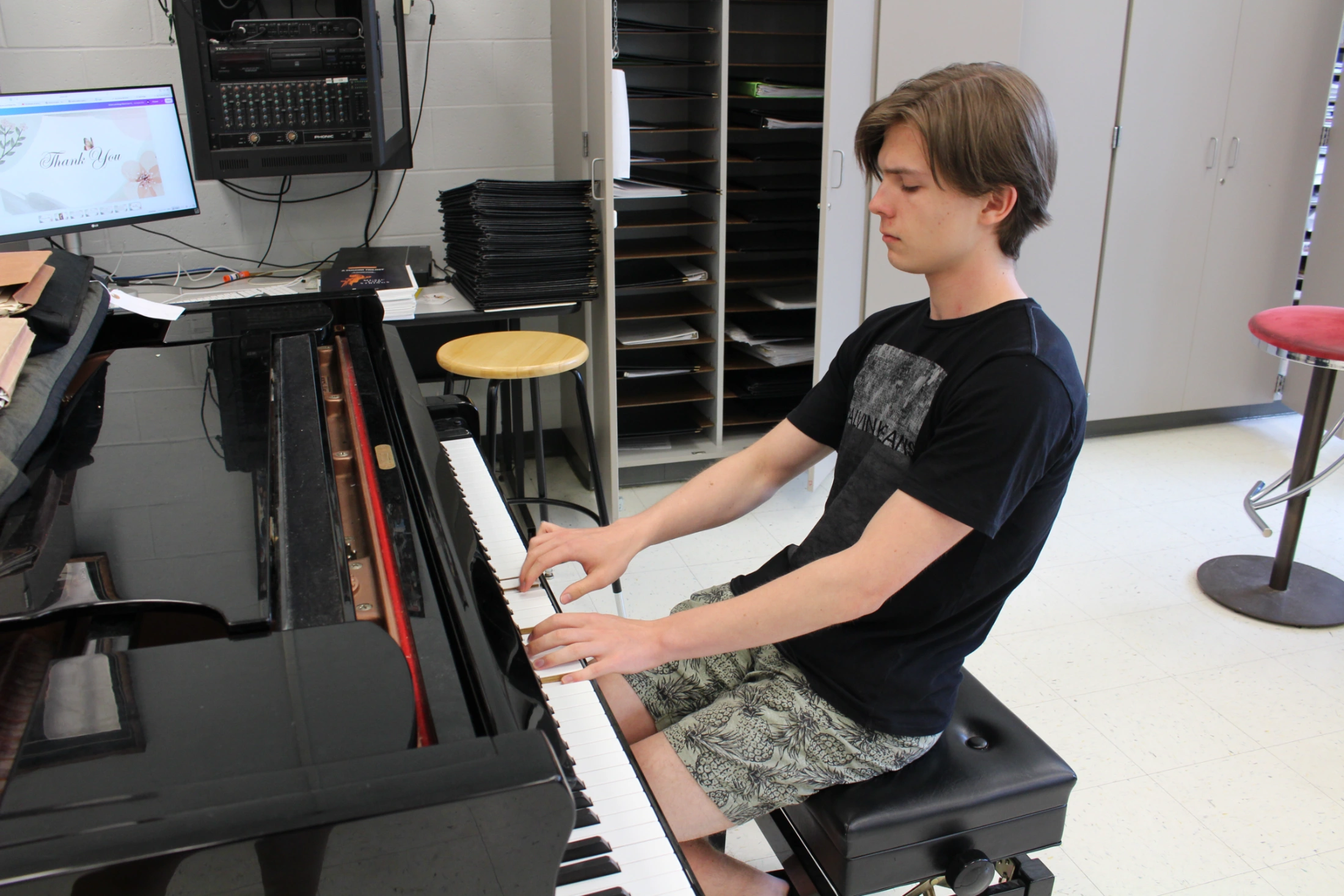
From PHS Jazz Ensemble to the Juilliard School Pre- College program, Daniel Haiduc ’26 has explored a variety of outlets for his musical passion. As a pianist and leader of the Harmony Project, Haiduc’s performance philosophy is centered around giving back to his community through music. Haiduc hopes to continue playing in the future as he enters college.
How did you start playing the piano?
I was in first grade and my mom signed me up for ... an afterschool program where you learned to play on some mini keyboards, and initially I didn’t really enjoy it much. I remember my mom had to learn the pieces I was supposed to learn and then she would show off in front of me to motivate me to play. So [I started at] around seven, and then I started to fall in love with it when I was 11 or 12, and that’s when I got to the point where no one needed to remind me to practice or anything like that.
Do you have any musical inspirations? How have they influenced your work?
First and foremost, my teachers are always an inspiration. When I was starting in seventh or eighth grade after moving to Princeton, I started studying with a teacher here. Her name’s Ingrid Clairfield, Mrs. Clairfield. She taught me the importance of using your music to give back to your community and to make a difference ... as opposed to just winning competitions. ... And this is something I do every year, actually here in the PAC. I give recitals to raise money for the Children’s Hospital of Philadelphia. It’s called a performathon and it’s a bigger effort across New Jersey. ... Another [inspiration] is [PHS’s bands]. Starting from seventh grade until tenth grade, I was in the band. In ninth grade, I did PHS Jazz Ensemble, and then tenth grade into the Studio Band. ... That’s where I really began to enjoy listening to a lot of jazz music. ... Nowadays I [don’t] really improvise because I’m a classical pianist [but] I like to play a lot of like written-out jazz stuff.
How do you prepare for performances?
One thing I’ll do is I’ll go on Instagram Live just to simulate some of the pressure or nerves I might be feeling on performance day, and sometimes a friend or two will pop on and they’ll say something. The day of [the performance], I like to have a routine. I’ll schedule everything so I have a plan. When I’ll wake up, I might do meditation. ... I try to get [to the venue] a bit early to have time to settle down, ... I’ll scope it out a bit, get some water, and then in the minutes leading up to it, I like to close my eyes, take a couple deep breaths, and just be aware of my five senses. So I think [about] what I’m hearing, [which] might be my breathing, might be the audience, might be whoever’s playing before me. ... Then I’ll do what’s called four-seven-eight breathing, where you inhale for four [seconds], hold for seven, and exhale for eight. ... And then I’ll give myself some words of encouragement and motivation, and I’ll walk on. ... I take three deep breaths and then I start.
What is the biggest challenge you face regarding music?
Piano is very lonely. I guess if you’re in the orchestra, you’re around people ... but unless you’re a soloist, you don’t really get to play with the orchestra much. But you’re all by yourself in the practice rooms. I mean, it’s probably the case for other [instrumentalists] as well, but there’s not a lot of people in the world that really understand or can tell the difference between how I might play and how someone else might play, but yeah, it’s pretty lonely.
What has been a memorable experience from your time playing the piano?
One that comes to mind is [from] when I was in seventh grade, I think it was right when COVID started. It was this piano competition, it was the final round. And I had some issues with my hands ... like pins and needles. ... After I started playing, it was so bad that I basically couldn’t move my fingers. I pushed myself to play through the piece, but it was a pretty traumatic experience. After that, I didn’t touch the piano for a couple weeks. That’s when I started to do some research and I found this guy named Jim Taylor. He’s a sports psychologist and he writes books about different techniques you can use, like breathing and meditating. So I started to try and incorporate some of those into my piano playing, and they took a year or two, but eventually I was able to regain my confidence.
In the future, how do you see music factoring into your life?
I’m not too sure. I ... probably won’t pursue ... a career in music. [It’s] difficult, because I applied to college this year and so I was thinking “should I do a dual degree program or should I just play on the side,” but eventually I just decided ... [that] I might minor in it. I’ll probably just keep playing whenever I have the time and I won’t stop, because I feel like that’s such a shame. I’m here, I put in all this work. So, I’ll keep playing, but probably more as a hobby as opposed to a career. I won’t be as locked in.