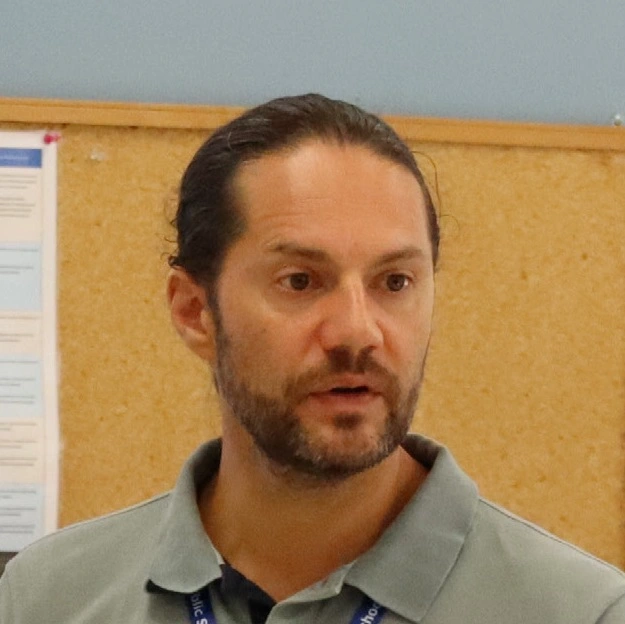
Theodor Brasoveanu, PHS’s new computer science (CS) and Python teacher, has been teaching CS for 10 years and has a love for coding and problem solving. He hopes to share his passion and expand on the same principles he learned about CS to his students.
“Some of my goals are to get everybody to see the applications of computer science. … It doesn’t mean you’re going to become a professional coder, but it helps you create connections between different fields, and helps you solve problems,” said Brasoveanu.
Growing up in Romania, Brasoveanu believes that his high school teachers had a large impact on him and in fostering his career in computer science. Their influence was felt in actions as simple as being patient in his ability to learn from lessons, to encouraging him to join competitions and meetings outside of school. Brasoveanu moved to the United States for college, deciding to pursue computer science professionally in graduate school. He later became a Princeton resident and taught CS at Princeton Day School.
In his first few weeks at PHS, he has taken note of several details in the school, emphasizing the willingness of students to help one another as a highlight of these observed behaviors.
“So far, it seems like a great community. … Students seem to be willing to help each other,” said Brasoveanu.
Brasoveanu also mentions that the background that an individual has in other subjects may affect their accomplishment in computer science class.
“In computer science, it helps to have a quantitative background, so maybe some students who don’t have a really strong math background might find it a little bit harder,” said Brasoveanu. “On the other hand, other skills help too, so if you’re more creatively inclined, [or] if you like to tinker with things and try different solutions, you can succeed.”
Additionally, Brasoveanu emphasizes the value of computer science in today’s world and how everyone should make an effort to attain a baseline knowledge of the technology we use daily.
“CS is important because it teaches us how to be technologically literate and how to engage with technology,” said Brasoveanu.
Approaching a problem in multiple ways is a key idea in Brasoveanu’s teaching philosophy. All attempts, regardless of the level of success, should not be disregarded or forgotten, but rather noted and used in future reference so they can be learned from, according to said philosophy.
“One way would be to keep a journal of all of our problem-solving attempts. … Get into [the] habit of taking good notes so you build your own resource library or just materials,” said Brasoveanu.
As for individual interest, animations are among Brasoveanu’s favorite creations to make in Python, though this is not the only application of the software.
“We use Python for graphics, for music making, for game design,” said Brasoveanu.