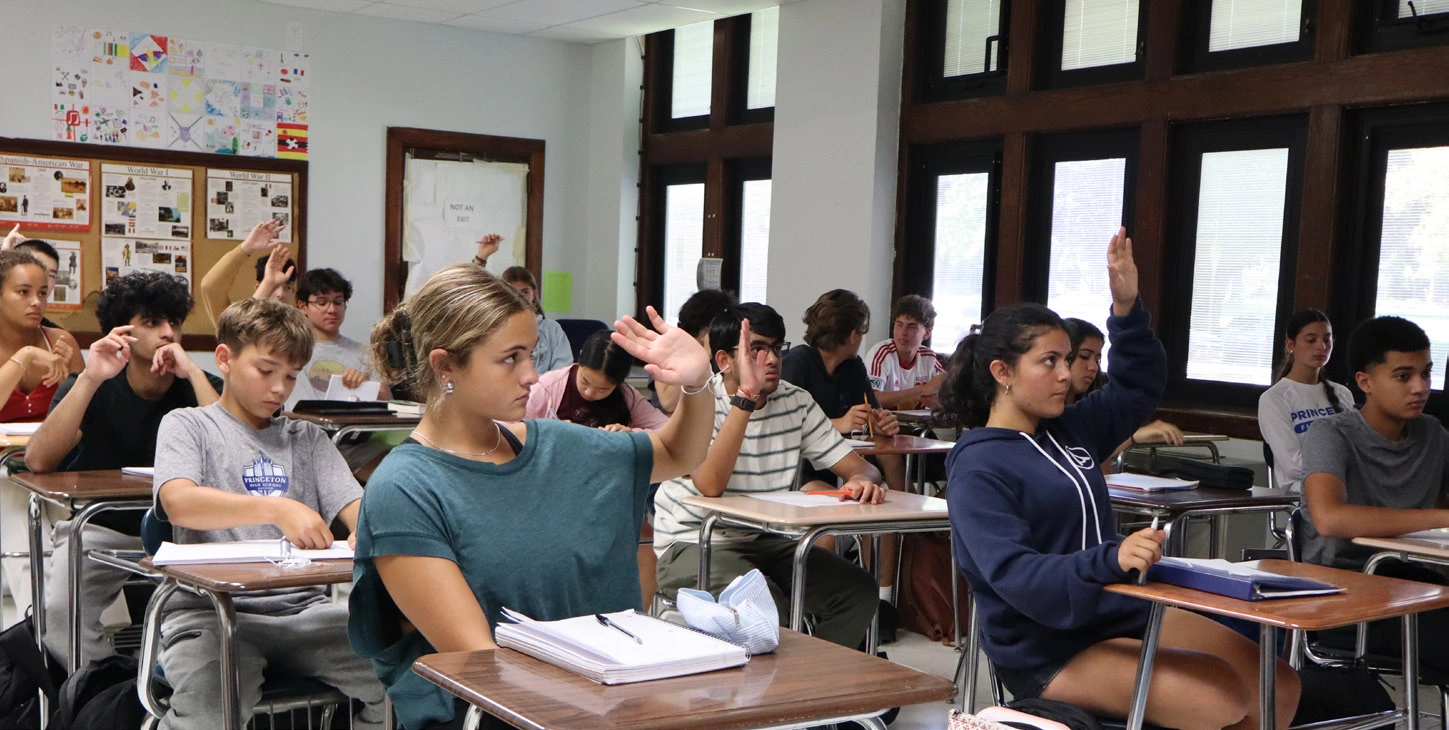
Over the summer, Princeton High School’s Social Studies Department introduced changes to its curriculum and program of studies. These changes were spearheaded by the district’s new social studies advisor, Dr. Rick Miller, a long-time AP US History teacher. These new changes introduced AP African American Studies and lifted restrictions on juniors taking more than one AP social studies course.
APUSH and AP Government and Politics teacher Timothy Campbell believes the previous course restrictions on juniors were implemented to reduce students’ school workload.
“They were trying to cut down the stress juniors were under, especially considering those who were taking AP World History at the same time,” said Campbell.
Campbell and other members of the history department had been advocating for this change for several years, noting that other departments allowed students to double up on courses. Following the expansion of AP Government and Politics to juniors, the number of class sections rose from three to five.
Campbell also spoke about the importance of making AP Government and Politics a more accessible class for students, given the country’s political state.
“I don’t think there’s ever been a more important time in our nation to take a course like Gov Pol. When I was in high school, for example, we had to take it to graduate. It was a graduation requirement at the state level,” said Campbell.
While the humanities program at PHS remains more sequential, the science program allows for more course choice. Jacqueline Katz, head of the Science Department at PHS, attributes this to the different departmental structures.
“I see a lot of synergy there in how departments think about learning progression and how best to move students through the various levels. [But] that looks a little different depending on the content we’re dealing with. A transition between US I and US II is going to be different than a transition from Bio to Chem where you’re traversing disciplines rather than extending timelines,” said Katz.
PHS Principal Cecilia Birge believes that, when restructuring the curriculum, it’s crucial to keep changes that don’t involve AP course offerings or restrictions in mind.
“It’s really important that we’re not singling out AP courses, because we offer plenty of accelerated courses. And when we talk about program designs, we’re a public school, we’re here to serve all students,” said Birge. “If we’re only talking about AP courses, not only are we marginalizing everybody else, [but] we’re only focused on accel students. We end up marketing APs for the label of it.”
These departmental differences extend to summer pathways at PHS. PHS offers summer courses for both math and science, but not for English or social studies. According to Birge, these summer programs initially developed during Covid-19 when school shifted online, and a reliable replacement for previously private summer programs was necessary. Today, the income generated from the summer program funds bridge programs for low performing students that aim to close the achievement gap.
Birge emphasized the importance of updating the school’s social studies curriculum, as the liberal arts remain extremely important to PHS. She pointed out the tendency students have to overlook opportunities in the humanities, and why it’s important for the school to take action to prevent this.
“We are very much for whole child development, [and for] the liberal arts kind of education,” said Birge. “It’s great that we have opportunities in math and science or languages and arts, but we want to make sure that’s extended to all kinds of talents that we have in the building.”