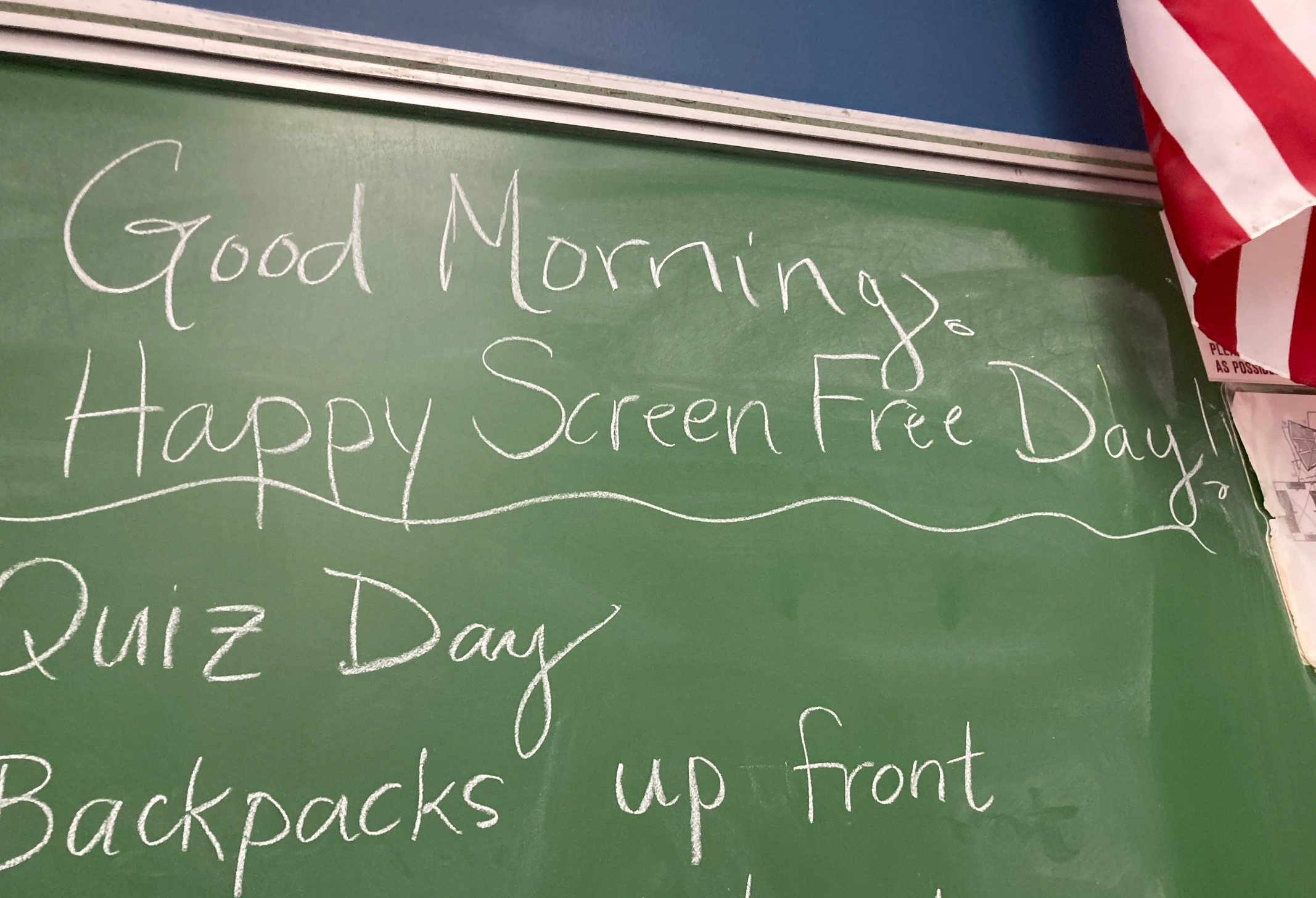
On Friday, October 30, the first ever screen-free school day was implemented across Princeton Public Schools. At PHS, it was nicknamed the PHS Unplugged day, with blue posters hung up around the school advertising the technology detoxification.
The screenless day was intended to counteract the growing influence of screens in post-pandemic education, and to push schools to experiment with device-free learning. However, exceptions were made for seniors so that they could work on college applications if needed during break or personal free periods.
“I think the idea is to sort of experiment … to try to help people figure out when devices are really of educational value and when they’re not needed,” said PPS Board of Education member Eleanor Hubbard. “Because if they’re being used when they’re not needed, then they also present distractions.”
The screenless day will repeat quarterly this year, with the next one scheduled for January 15. The event has not yet been confirmed to be returning next year.
“I don’t know if it’s a permanent thing,” said Hubbard. “I think it’s a pilot. The idea is presumably to challenge teachers and students to think about what it might look like … to not have students on devices in the classroom.”
Some students reported that some of their teachers loosely enforced the rules. Amelia Huang ’29 noted the event conceptually can have benefits for students, but could inhibit classroom schedules for teachers.
“If it were properly enforced, I think the best part would be that students wouldn’t be distracted [by] games and [other] stuff on their computers,” said Huang. “But the worst thing is teachers who rely on computers [for teaching] a lot would be inconvenienced for a single day, and it would disrupt the flow of classroom activities.”
The no-tech day was extended across the district and implemented for students as young as elementary-school age. It looks to address the concerns of many about the overexposure of young children to screens, as the elementary schools take action to turn further away from screens at break time.
“[It is] emerging out of concerns about the omnipresence of technology in children’s lives and a desire to have schools be more of a face-to-face environment where students are really engaged socially [and] talking with each other,” Hubbard said. PHS Journalism and English teacher Courtney Crane also related the screenless day to the phone ban, commenting on the recent district push toward less screen usage.
“I can’t say this for certain, … but most classes that I came into [last year], as students come in, they’re staring at … a phone or a computer screen, and there was very little eye contact sustained throughout the class,” said Crane. “But looking at it this year, that’s different.”
Although she doesn’t think one day will change everything, Crane added that the unplugged day is more about the core intentions than an immediate reform.
“I think for the school to take a stand on getting students off screens is important. Now, does that mean that it has to be one particular day every quarter, … I don’t know about that,” said Crane. “The big picture is [that] we need students to be able to make eye contact and have conversations with one another.”