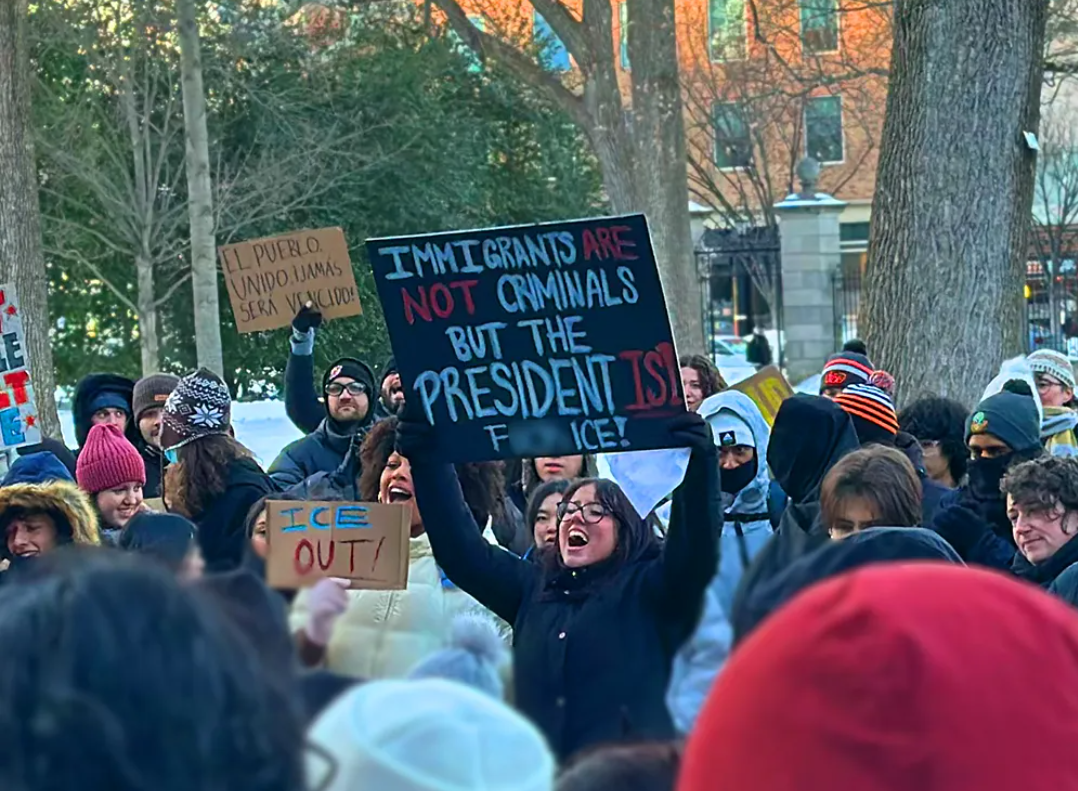
On February January 30, the Princeton Progressive Coalition, an alliance of progressive student groups at Princeton University, held a protest at Princeton University’s School of Public and International Affairs’s (SPIA) fountain, also referred to as the Freedom Fountain. Princeton University students, community members, and Princeton High School students gathered to protest against the U.S. Immigration and Customs Enforcement (ICE) and its recent actions in Princeton. They held signs that read “ICE Out” or “No One is Illegal on Stolen Land,” listened to different speakers from the coalition, and chanted phrases such as “the people united will never be defeated” as they walked along Nassau Street.
Among the protesters were several PHS students, including Semira Schutz ’27 and Paloma Maya ’28.
“I wanted to join [the protest] because what’s going on with the ICE raids and everything, it’s totally wrong,” said Schutz. “People are getting taken away from their families, people are getting their fathers taken away, their children taken away, which is insane to me … It’s just not right. And that’s why we wanted to take a stand.”
For many PHS students, involvement in this protest was inspired by local activity. On Wednesday, January 15, during school hours, an ICE raid occurred a few blocks away from PHS. Agents were initially spotted near the intersection of Birch Avenue and John Street. In response, PHS administration decided to place the school in a shelter-in-place from 10:47 a.m. to 11:55 a.m.
“Knowing all of these situations, the best way to manage it is for us to stay put,” said PHS Principal Cecilia Birge. “That allows authorities to figure out what is going on and then make sure that off-campus is as safe as inside the building.”
Under federal law, immigration enforcement officers — like any visitors seeking access to a student or the school building — must present the required documentation. In ICE’s case, this includes a judicial warrant. Due to the lack of direct communication between federal agencies like ICE and the school districts, each school takes different approaches depending on their age group to keep students safe.
“If any person comes to [the] schools, it doesn’t matter if it’s federal immigration enforcement or other visitors … they need certain documentation to be able to access a student or come into the building,” said PPS Superintendent Michael LaSusa. “If they don’t have that, and even if they do say they have that, they have to report to the superintendent’s office so that I can verify whatever they are presenting and reach out to our board attorney to confirm that.”
Despite these administrative protocols in place for safety, limited information during the shelter-in-place led to widespread uncertainty among students. As a result, rumors spread quickly, especially after an ICE sighting was reported at Community Park Elementary School. Some students attempted to contact their families about the situation, while others were left guessing.
“It was just very confusing,” said Jane Berkery ’29. “Someone told me that they took a kid from [Community Park Elementary School], which was not true. They took the kid’s dad. And so … I was concerned because I [thought], ‘Oh my God, they’re going to schools.’”
Because information about ICE was only passed around by word-of-mouth, teachers were not permitted to directly explain to students the reason for the shelter-in-place. However, each teacher took necessary precautions to ensure the safety of their students.
“I was teaching my ESL class that period, so particularly amongst that demographic it was really upsetting,” said history teacher Dr. Katie Dineen. “So immediately, we continued the day as normal, but took every precaution we could to make sure not only our students were safe in the building, but safe getting home that day. So there was a lot of organizing, both within the school and with community organizations, to ensure that students felt safe.”
In the aftermath of the incident, students and teachers responded in different ways to protect and support each other. Jennifer Smolyn, a cross country and track coach at PHS, kept the track team running close to school, and required check-ins after their run to account for everyone’s safety. Jasmine Taylor ’26, a leader of the Anti-Afrophobia Club at PHS, organized a presentation on procedure in case of an encounter with ICE agents, and also distributed red cards listing legal rights that people could reference to minimize contact and conflict with the agents.
“It’s gonna affect you no matter if you’re a U.S. citizen or not … especially [people of color], they’re not going to check,” said Taylor. “I feel like a lot of people want to look away and you can’t really.”
The incident left many at PHS worried about the future as well as vulnerable immigrant communities, especially as ICE activity has increased across schools and neighborhoods nationwide.
“I know how much this is affecting the families, how it’s breaking the families, how it’s affecting their daily life. They have no trust in the police or the hierarchies,” said Idania Rodriguez-Mejia, a Spanish teacher at PHS. “I’m living [in] fear … It’s shameful what’s happening and what our government is doing.”