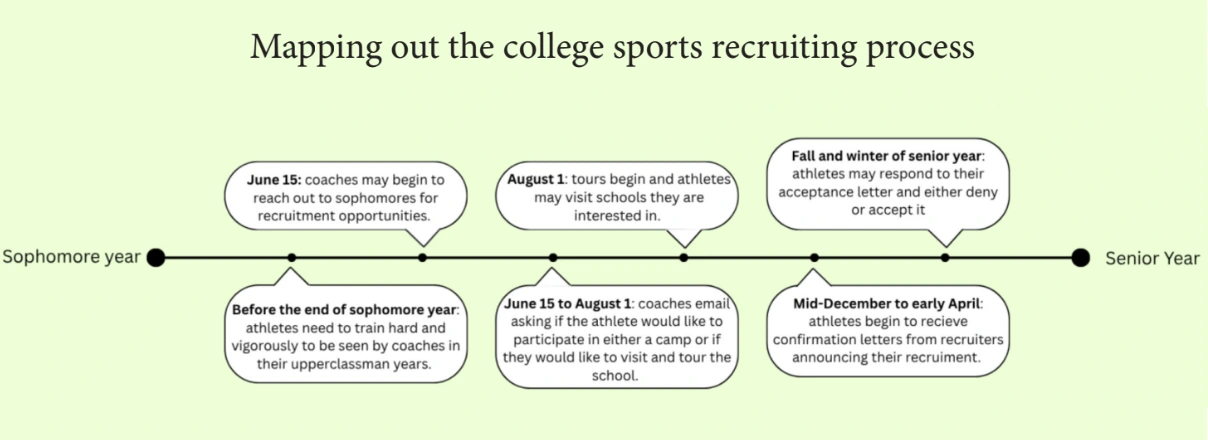
For high school athletes, playing a sport in college can seem like a simple goal: work hard, get better, reach out to coaches, get recruited. In reality, the college recruiting process can start years before an athlete ever steps onto a college field or court. Between tournaments, emails, visits, academics and contacting coaches, athletes have to figure out how to stand out in their sport while also balancing their demanding high school schedules.
For squash player Eric Zhang ’27, ranked third in the state, the idea of playing in college started early. His parents originally put him into squash partly because they thought it could help with college admissions, but Zhang said he did not seriously consider being recruited until his freshman year.
“I love competing,” said Zhang. “I love practicing. I love playing, and I guess I was just good enough to play at the college level, so why not.”
Zhang’s recruiting process officially finished around October of his junior year. Looking back, he said much of the process involved communicating with coaches. He was in contact with six or seven coaches at the time, usually having a call with each coach about once every two weeks. Eventually, he went on several college visits that lasted one or two days.
For Zhang, getting noticed by coaches came down to three main things: competing at high level tournaments, attending college showcase camps, and reaching out to schools himself.
“I went to two summer camps [to] meet the coaches and see the campus, and then lastly, once recruiting started, I emailed all of the prospective schools that I wanted to attend,” said Zhang.
Tournaments, rankings, and statistics were especially important for Zhang because coaches often attend competitions looking for potential recruits. He said that having strong results can help athletes stand out when coaches are deciding who they want to recruit. Academics are another major part of the process. Zhang mainly spoke with Ivy League schools, where grades and test scores can play an especially important role.
“For most schools, your academics are more of a threshold that you have to meet rather than a differentiating factor,” said Zhang.
While Zhang has already completed the recruiting process, now commited to Yale University, Greta Knierim ’27 is still working through it. Although Knierim also plays basketball and volleyball, she plans on committing to play softball.
After suffering a major knee injury as a freshman, she began thinking more seriously about playing softball in college, but she did not really start focusing on recruiting until the summer before her junior year, a choice that she regrets in hindsight.
“Start now. If you’re a freshman, [or] if you’re a sophomore, start now,” said Knierim.
One of the biggest lessons Knierim has learned is the importance of exposure. She said playing in large showcases and attending prospect camps can make a difference because college coaches and recruiters are more likely to be at those events.
She also emphasized the importance of consistently communicating with coaches. Knierim uses recruiting platforms such as Sports Recruits and Field Level, along with email and social media, to contact and stay connected with coaches.
“Consistency is definitely key,” said Knierim. “People aren’t going to notice you, or colleges aren’t going to reach out to you, if you email them once a month. I’m talking twice a week, once a week, for four weeks consistently.”
The process can also be difficult mentally, forcing athletes to be pragmatic about which schools are actually possibilities. She originally hoped to play at the University of Florida, but being a New Jersey athlete made regularly attending showcases and camps in Florida difficult.
“Being realistic, I want[ed] to go to the University of Florida for softball,” said Knierim. “That’s an SEC school in Florida, it’s D1 ... [but] the more I [went through] my recruitment process, I was like ‘yeah, this is not gonna work.’”
Both athletes agreed that academics should not be forgotten while pursuing athletics. Knierem said that athletes need to be strong both academically and athletically, while Zhang found that academics were one of the biggest factors in his eventual college decision.
Although recruiting can feel overwhelming, Zhang said there is little reason for athletes who have the ability to play in college not to try.
“I [would] say [just] go for it. There’s nothing to lose, there’s really no risk at all, so why not just try? Even if you change your mind, no one’s forcing you to play,” said Zhang.
For younger athletes, the recruiting process is not something that has to be figured out all at once. It can begin with simply researching schools, improving their sport, keeping their grades up and learning how to communicate with coaches. As athletes get older, their list of potential schools can become smaller and more realistic.
College recruiting may look different for every athlete, but the same basic idea remains: preparation matters. Starting early, staying consistent, and finding the right balance between academics and athletics can make the process much more manageable.